
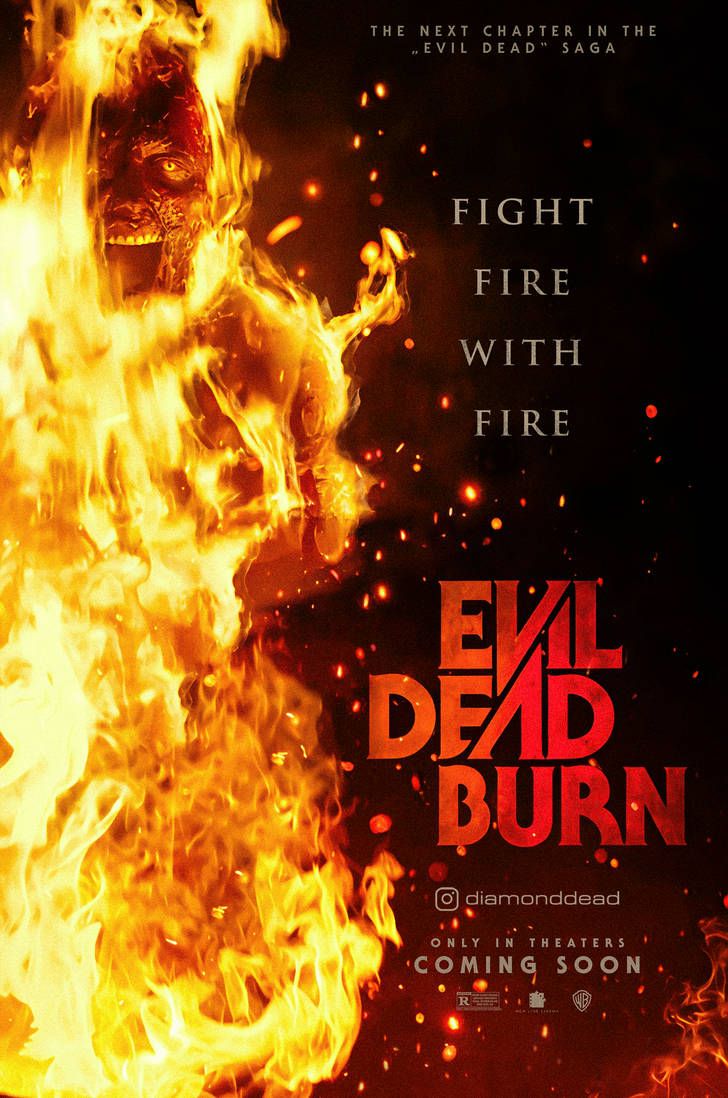
There are two specific contrasting traits of horror at the start of the new English horror film Evil Dead Burn. One involves the setting of a lake that is witness to the brutal and gory killings of two campers by the hands of a Deadite. And the second involves a disturbing argument unfolding between two characters. While the former remains on par with the horror quotient of the Evil Dead franchise – something hasn’t degraded since its inception, the latter is more aligned with the recent trends of horror films known to tackle social issues. So when you are introduced to Alice (Soheila Yacoub), she is in the middle of an argument with her husband William (George Pullar) – even as the latter remains a possessive and short-tempered character in the wake of the recent ‘Alpha male syndrome’ on celluloid, on the lines of Kabir Singh or Arjun Reddy. There is a different subtext to the horror in their dynamics, much of which is possibly endured by the protagonist Alice off-camera – something that we get only glimpses of along the way. But little does she know that her tryst with horror would be as much external as it was internal to her – even as the turn of events leads to the mysterious death of Will whilst transforming him into a Deadite.
Written by Florent Bernard and Sebastien Vanicek, one of the central themes of Evil Dead Burn remains that of domestic violence, even as the protagonist visits her in-laws for the funeral of her husband. You instantly witness a disconnect with most of the family members towards Alice, even as they are shown to be mourning the loss of their family member. The only possible connection that is on display remains that between Alice and Joseph (Hunter Doohan) – Will’s brother, and his partner Thya (Luciane Buchanan), even as others including Susan (Tandi Wright) – Will’ mother, Edgar (Erroll Shand) – Will’s father, and Polly (Maude Davey) – Will’s grandmother (with a quirk), don’t instantly take a liking to her.
The familiar beats of the franchise steadily set in, even as the contrasting beats of horror are on full display here. So whilst in a scene, you witness a character resenting the presence of the protagonist given that her grieving style does not match theirs, you see a brief demonic episode involving another character who gets ‘infected’ – thereby triggering a chain of events in the household. One includes a brutal murder of an animal following a dinner table conversation that keeps the layers of tension in check. The other in another confined setting of a moving car, wherein the attack is sudden and brutal – while also exposing the brief character traits of a few characters.
One minor criticism that I had with the writing was with respect to the characterization. The specific traits of vulnerability that were showcased, needed a little more context for a larger impact – something that could have further elevated the drama to the next level. For instance, an integral plot-point involves the Deadites exploiting the emotional vulnerability of the characters in order to possess them. And while the gore and violence remains on point, the exploration of the emotional state of the characters in terms of the vulnerability remains the missing link – the answer to which would probably lay in their past. And this specific angle needed a little more exploration – even amidst the fun that I had while witnessing the horror elements unfold through sequences that had me clinging on to the sides of my chair.
The specific sequences of gore that had me intrigued was one involving a character repeatedly banging in a blunt object on the face of the infected. Or a specific instance of an infected character smearing the dentures of another ‘disabled’ character to get her infected in return. Or even a very specific moment of vulnerability that was well executed – wherein an infected character shares a passionate kiss with another. Each of these instances stood out for showcasing the different shades of gore – one being brutal, one exploring the quirks of disability, and the final one offering a distinct state of vulnerability that remained one of my minor forms of criticism.
I couldn’t help but also think about the convenience of the final act – even as the elements of lore (with respect to the Book Of The Dead, and its ‘anecdote’) that were strategically placed throughout the narrative, finally found a voice. The brief issue lay in its simplicity – almost allowing the shock value to take centerstage with brief streaks of quirk, something that had me a little on the fence. But the gore in itself is so powerful, that it had supersede and overpower the points of criticism that I had with the finale.
There is a mischievious energy during the face-off that circles back to the point of domestic violence in a circle of karma that would eventually complete. And that energy, although messy in parts – does signal a very specific note of quirk that inter-mingles with the plot-point of revenge in a very different context. From the POV of Alice, it might also be a coming of age tale of horror – something that instantly taps into a quirky space, given the context of the situation. The screenplay is laced with these fun moments that are hard to ignore despite their share of flaws, and that ultimately keeps the boat sailing in a horror franchise that refuses to slow down or downgrade at any point.
The dialogues possess a specific streak of tension that often precedes the gore in the mix. For instance, the initial verbal fight between Alice and Will that is lead to a bout of gore for the latter. Or a tense dinner table conversation that ultimately ends on a brutal note. The BGM perfectly compliments the gory themes that the drama has to horror, often heightening the fear quotient in the drama with a heavy background score.
The cinematography comprises of frames that refuse to dilute the elements of gore and violence – presenting a character whose head is about to be sliced off, or the pointed head-support of a car being pierced through the jaws of another character. The one thing that I would have liked a little more was a slight deviation into the emotional psyche of the characters – which through the frames would have added another dimension to the drama. In that sense, even the production design is immaculate – seamlessly doing its bit to shift the ambience of the drama.
The editing pattern is uses transitions wonderfully well. In a scene, you witness a character pocketing a knife, only for the scene to transition into a character slicing pieces of meat with a knife. Or in another instance, a horrifying incident transitioning into a night-club that adds to the shock value. Or even a character being injected with a rod only to transition into a scene involving a skewer. Each of these instances offer a quirky dimension to the drama that absolutely hits home.
Director Sebastien Vanicek does a pretty impressive job in exploiting the gore which is prevalent in the drama. There is an eerie atmosphere that he taps into – with the tensions surmounting from it, often superseding the characterization on display. And despite the latter being a little underpar, the former is strong enough to drive the narrative to the point that I felt like overlooking a few flaws with the direction. The direction in itself is pretty impressive, and something that keeps the ‘horror’ needle ticking through situations and passages that are intriguing and entertaining to witness.
The performances are wonderful by the members of the cast. Tapiwa Soropa as Mike, Keanu Karim as Jared, and Greta van der Brink as Jessica kick off the drama impressively with a lot of gore, while putting forth commendable acts. George Pullar as William has a specific toxic trait tagged to his character, something that he exploits with a lot of flair. Maude Davey as Polly ably contributes to the quirk in the narrative with some palpably funny one-liners that offer a different dimension to the drama. Luciane Buchanan as Thya is phenomenal to witness, while creating a sense of fear through her body language and expressions that absolutely hit home. Erroll Shand as Edgar is a treat to witness too, creating an aura of fear through his brutality employed on characters around him.
Tandi Wright as Susan is wonderfully well restrained while putting forth a well measured performance in a character who is also subjected to bouts of trauma and abuse over the years. Hunter Doohan as Joseph offers an affable presence, while silently being a perfect foil for the protagonist to thrive in – until the ‘switch’ at the end. He is sincere and earnest with his act. Soheila Yacoub as Alice has a solid screen presence, even while presenting bouts of vulnerability and trauma with restraint and grace. And even in scenes involving a fight-back, he doesn’t let go of the trait of fear – something that tremendously works in the context of the drama. She is wonderful to witness in a terrific performance.
Featuring standout performances, Evil Dead Burn is a deliciously gory horror thriller that successfully maximizes its fear quotient despite a few narrative shortcomings. While the film occasionally stumbles with thin character development, these flaws are quickly overshadowed by relentless, stellar bouts of terror. The visceral gore had me white-knuckling the armrests of my seat, ultimately delivering a highly satisfying, edge-of-your-seat cinematic experience. Available in a theatre near you.


