

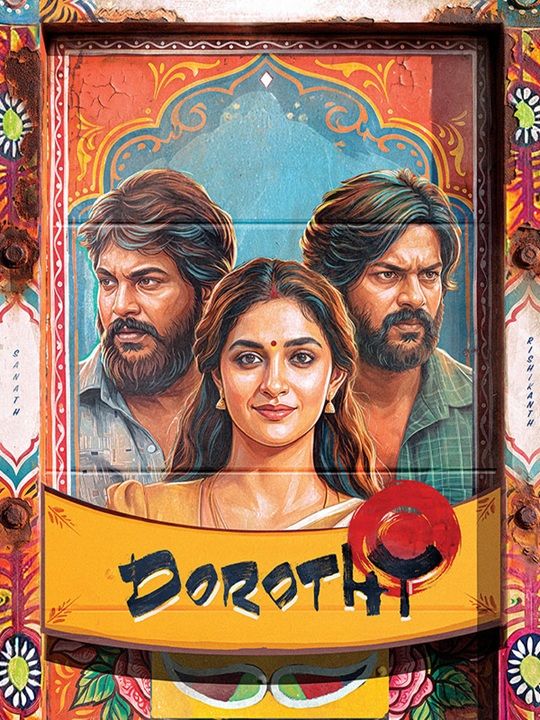
A fleeting element of alter ego connects the timelines and characters of the Tamil film Dorothy. The former represents an arc of its own – oscillating between a monochrome to represent the present and a gritty hue of yellow and brown to detect the past. Ironically, each of these palates are reflective of the characters in the mix – much before the ‘dust storm’ swerves the screen. While the present timeline hints at a murder of a character, the past showcases hints of masculinity, even as you are introduced to the younger versions of the protagonists – Karthi (Rishikanth) and Subbu (Sananth). On a side note, notice the names of the characters that also form peculiar alter ego forms of the psyche of the filmmmaker Karthik Subbaraj – borrowing names of his characters from himself. It hints at an interesting bit of ‘inclusion’ in hindsight – emphasizing on an individual having both these ‘traits’, much like his characters. This, while also emphasizing on the concept of evolution – terming it as a journey of realisation and acceptance, both physically and metaphorically over the course of the drama.
Written by Karthik Subbaraj, the streak of masculinity is what defines the cold open of Dorothy – even as an injured Karthi is protected by, and forced to fight back by Subbu. The latter draws his rebellious inspiration from Bruce Lee, having being brought up in a patriarchal household without the presence of a mother. Hence, his idea of a retaliation always is in the form of violence – an ‘alter ego’ of masculinity, something which is further iterated when he tells his new found friend to stop crying; given that men don’t cry. This remains in sharp contrast to Karthi who is a quinessential underdog to begin with – born in a lower caste family (unlike Subbu), and having been brought up by his mother.
The inference of a caste discrimination is felt in a particular scene when a young Subbu invites Karthi for the first time to his house for lunch – only to be stopped and non-chalantly questioned by Veeraiya (Muthukumar), Subbu’s father about the same, before sending them outside to eat. It is worth noting on how Veeraiya remains the perennial patriarch, often wishing for control in his immediate environment – even if it would mean to take lives or marry off a girl, all in order to protect her from entering a family of a lower caste. The influence of power here also doubles up as an ‘alter ego’ of patriarchy, something that is laced with gender discrimination.
It is interesting on how the writing intermingles the arcs of the two protagonists – just like two interjecting parabolas, while grounding the drama in a gangster setting. The world is built on the fundamentals of masculinity and the concept of the alpha male, even as the two protagonists are on the cusp of their first murder. And yet, a glimpse into their grown-up selves indicate that the concept of masculinity has been transferred from Subbu to Karthi – making the latter a fierce beast, ridden with long hair and a menacing beard. The latter showcases similar physical traits but remains the softer one, shying away from the eye of violence – an important trait that will define his character moving forward.
I loved the feminine touch in this world, gently cutting through the fabric of masculinity and patriarchy. Be it a scene involving the character of Karthi’s mother, who wholeheartedly welcomes Subbu into her household – terming him as her son, hugging him and assuring that it is okay for men to cry. Or a scene involving Subbu’s friend who offers a bout of compassion in the moment towards Subbu, who just wanted to share his vulnerability with her. Or even the introduction of Dorothy (Keerthy Suresh), the sister-in-law of Subbu who doubles up as his confidante with gentle touches of softness, warmth and compassion. In fact, Dorothy could come across as an angelic presence who drops by,, serves her ‘purpose’ with Subbu, and leaves – painstakingly christening her persona of compassion before being consumed by the sea of patriarchy.
The proceedings showcase an arc of their own, gently transforming from a sea of patrairchy into a tiny tributary of femininity that flows against the tibe. This is through the transformation of a particular character that cuts through his facade and confines of masculinity, only to showcase his true inner identity – something that would also account for the lesser accepted, ‘alter-ego’ of gender and the representation around it. The conflict of his identity identifies itself in the spirit of acceptance, even in the lesser accepted variant of love that is known for gender discrimination. Ironically for this specific character, the bridge of realisation has been actively crossed – making him the victim of a privilege that he was born with, particularly with regards to his family.
It is interesting on how the drama has a genre change; a nod to the Malayalam film Moothon (2019) in a faint way, switching lanes from a gangster drama to essentially a road movie – the latter being a metaphor for the path of realisation. This is particularly true given how there are drastically two emotions and two conflicts in play with regards to the two protagonists – one being tasked with escapism from the toxic world that he was once a part of, and the other tasked with murdering him in order to protect the ‘pride’ of the folks from his village. The connecting tissue between the characters remains their eternal bond of friendship, a vital ingredient that consistently prevents the deed from being committed – often also interjecting the angst and frustration transpiring from the same.
There is a beautiful commentary on acceptance, putting the concept of companionship on the forefront – involving a subplot featuring a trans character who is previously abused, only for the tables to turn later on. The definition of the acceptance of love is what gently evolves in this coming of age phase involving the two protagonists – even when one of them reluctantly aims a gun at the other, while also subconciously protecting him from danger (like falling off the bus while he is sleeping). The emotional beats in the narrative are pure, and deeply moving – thoroughly strengthening the bond mounted on the fabric of friendship, love and companionship, leading upto a bittersweet moment of loss, solitude, and incompleteness. It is a beautiful harmony, that gently reaches its crescendo.
My only little gripe with regards to the screenplay arrived in the final ten minutes of the drama – when the writing itself got a bit self-indulgent with the concept. I could see what they were attempting – a subplot to complete the arc of a scene from the first hour, featuring the younger versions of the protagonists sitting in a theatre and watching an ‘adult’ kiss scene from a Hindi film. I liked the concept of the Hindi film because it reiterated the concept of ‘inclusivity’ whilst being an ‘outsider’ of sorts. The idea remained to recreate this same moment when each of the two protagonists have finally found their ‘love’, after a symbolic representation of a cock-fight in the middle. But an incomplete finish to this ‘pride’ tale had a higher impact than the idea of spoonfeeding the viewers with a final detail of ‘love’ in any shape or form. But barring that one tiny blip, the moment still is beautifully mounted – thereby summing up a screenplay that is extremely heartfelt, amidst a wonderful commentary on gender discrimination, realisation and acceptance.
The dialogues are veiled as soft nugget of emotions, coated with a hard shell of patriarchy – and served on a gentle simmering flame, that melts the outer layer and allows emotions to be consumed in its purest form. The melting moments of magic wonderfully touched me in several moments – be it the confrontational scene between the two protagonists in the final act, or Subbu’s tryst with Dorothy and other characters exhibiting a stream of femininity.
The music by Ilaiyaraja wonderfully mirrors the atmosphere of the world, ranging high from the crescendos of patriarchy to the gentle lows of femininity – forming an arc of its own. The BGM follows a similar trope, creating an atmosphere of masculinity in the interval block leading upto a crime, to the soften tones of emotions at the end to avert another – contrasting its notes, with the shifting landscape of the drama.
The cinematography by S Thirunavukkarasu comprises of frames that thematically representing the shifting canvas of the drama. Be it the inclusion of monochromes that is directly symbolic of emptiness, or the narrow tightly-boxed frames at the start that showcase claustrophobia as an ‘alter ego’ of masculinity for the society, transforming into the wider shots in the second hour that act as a refreshinh counter. Even the shifting landscape defines the colour grading of the frames – ranging from dusty hues to monochromes, and later bright and vibrant shades of ‘pride’, each representing a specific emotion. This, combined with some wonderful one-shot technique in a gruesome sequence involving a crime – the cinematography is magnificent.
The editing pattern by Ganesh Siva is supremely immersive, seamlessly intercutting the drama across two distinct timelines – and ably using the match cut technique on more than one instance to showcase the contrast of emotions in the same setting but in a different moment. The editing style is brilliant, and does well to beautifully hold the narrative togther.
Director Karthik Subbaraj offers his trademark brilliance yet again, this time in a drama that offers two contrasting worlds – ironically evolving through the lens of his two protagonists. There is so much craft in his filmmaking, creating moments of love, friendship, and acceptance – sandwiched in a commentary on patriarchy and masculinity that is presented with bouts of softness and sensitivity. The genre transitions aren’t as jarring as his previous underrated venture Retro (2025), beautifully lacing his drama with palpable emotions that are enough to melt your heart – particularly in a genre that isn’t known for it. The direction is brilliant here.
The performances are wonderful to witness by the members of the cast. Soundararaja remains a victim of patriarchy in his own sense, given his background of his household – and he has his moments to shine. Jeeva Subramaniam is the perfect emblem of inclusion, love and acceptance – beautifully blending with the themes of the drama and making a solid impact here. Muthukumar as the whistling Veeraiya is an emblem of toxicity, patriarchy, masculinity, and power wrapped in a single character who does come across as menacing and intimidating. And he is terrific to witness here. Keerthy Suresh as Dorothy looks angelic, and carries off her performance with a lot of grace and dignity. Her softness remains understated, her empathy remains sincere – and her emotions are enough to convey the warmth of her personality. She was excellent here despite a limited screentime.
Sananth as Subbu delivers a masterclass in emotional evolution as he portrays a poignant arc of acceptance. Beginning his journey with a grounded, quiet vulnerability, his character gradually embraces the complex realities of his world, moving from initial resistance to a profound, open-hearted submission to circumstance. Sananth uses subtext and gentle, sensitive mannerisms to convey this internal shift, ensuring his performance never feels forced. By grounding his character in authentic human frailty, he anchors the narrative’s heavier themes, bringing a beautiful, melancholic warmth to the table that lingers long after the credits roll.
Rishikanth as Karthi provides a brilliant counter-narrative through a powerful inverse arc of realization. While Sananth’s character moves outwardly toward acceptance, Rishikanth undergoes a deeply interior, intellectual awakening, slowly piecing together the gravity of his choices and relationships. His acting is remarkably restrained, relying on subtle shifts in expression and measured dialogue delivery to mirror a mind coming to terms with painful truths. This grounded, sensitive portrayal ensures his sudden moments of clarity feel entirely earned, offering a striking, emotionally resonant contrast that completes the film’s core psychological dynamic.
Featuring brilliantly heartfelt performances, Dorothy is a beautiful harmony of love, friendship, identity acceptance, and self-realisation that subverts themes of patriarchy and toxic masculinity within a gritty gangster drama, delivering one of the most emotionally fulfilling cinematic experiences of the year. In hindsight, the narrative formulates a profound arc of its own – one that seamlessly transitions from raw violence to tender love along a metaphorical path of self-discovery, making it a masterclass in storytelling. Elevated by its striking subversion of traditional genre tropes and deep emotional resonance, this poignant coming-of-age masterpiece may very well stand as the Best Tamil Film of 2026. Available in a theatre near you, and Highly Highly Recommended.


