

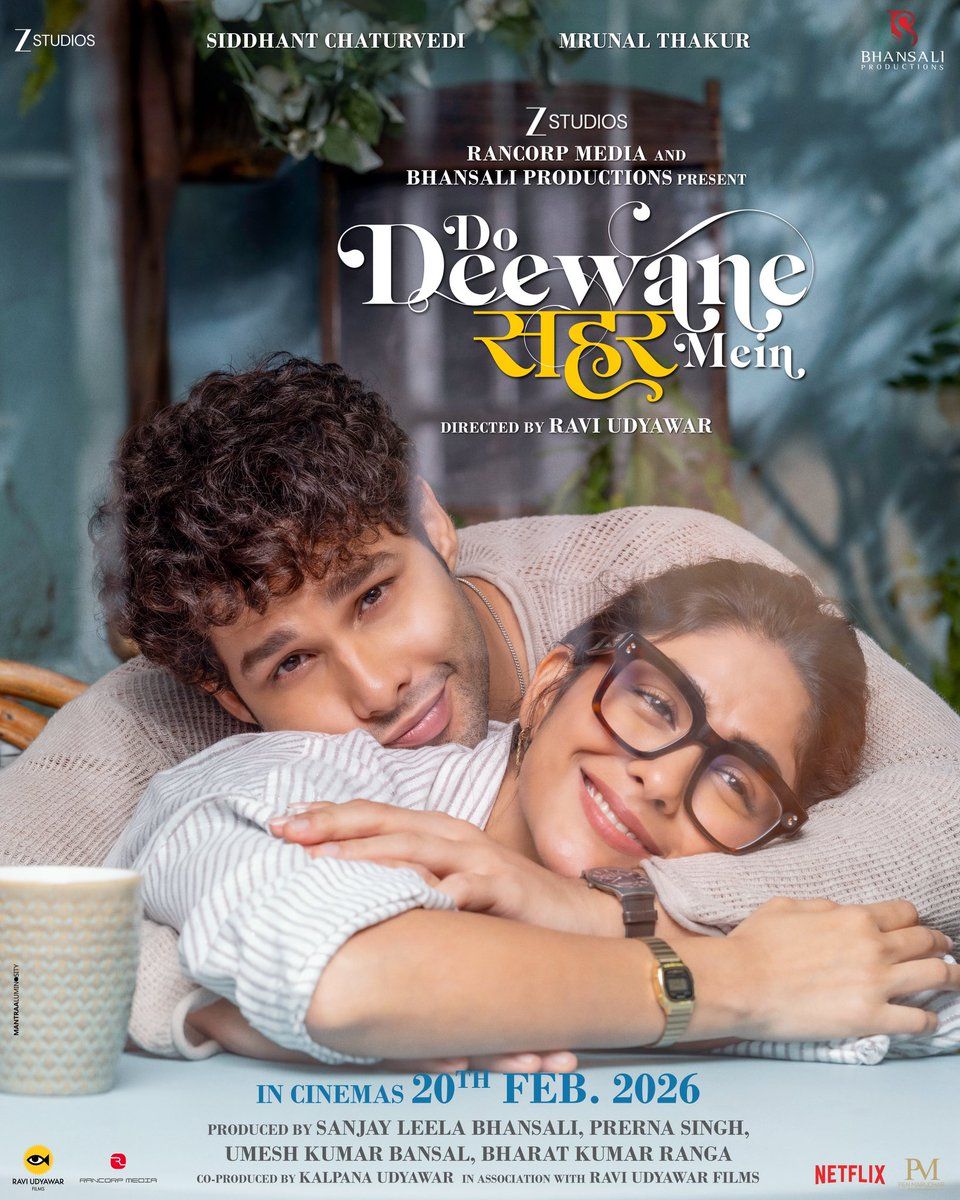
Both Shashank (Siddhant Chaturvedi) and Roshni (Mrunal Thakur) in the new Hindi film ‘Do Deewane Seher Mein’ are epitome of millenials whose lives are complicated and lonely while continuing to slog their way in the big bad city of Mumbai. Be it the semi-crowded metro-rides or the silent hustles at their workplaces, or a buried desire to find love – ‘Life In A Metro’ is distinctly complex for both individuals. In the same breath, both Shashank and Roshni are imperfect individuals – the former is a quiet little green-flag without a beard or boasting of six-pack abs, and the latter is a head-strong but deeply vulnerable character who is lost in her surge of work. In other words, both Shashank and Roshni are characters either around us that we have known for a while, or within us – characters that we play in the real world.
It is interesting also on how the bustling city of Mumbai plays a pivotal character here – a silent bystander of dreams and shifting dynamics that are aided and shattered in the social media era where the superficial emotion driving the generation remains – Good Looks, Good Looks…….and………Good Looks. The quieter moments in monsoons feel like a fleeting paradise even as the characters are momentarily drawn towards it, before returning to their ‘real’ worlds. In other words, the city of Mumbai is represented to be as flawed and imperfect as the leads here wherein it is more a case of ‘Metro…In Dino’ in what it takes to have a ‘Life In A Metro’.
Written by Abhiruchi Chand, it is interesting on how the lead protagonists in Do Deewane Seher Mein are tied together by a streak of underconfidence. In an early scene, you see Shashank skipping a board meeting simply because he doesn’t want to put himself on a pedestal. Essentially, he suffers from an inferiority complex that erupts from his inability to pronounce words correctly, lisping his way through his daily chores. In a scene, you see him hesitating while uttering the words ‘Washing Machine’, simply because the ‘sh’s don’t land for him (same goes for his and Roshni’s name, both of which he can’t pronounce clearly). The element of stage frieght is real – prompting him even to walk away from the interview round of the IIMs, despite having cleared the written exams. This, whilst Shashank remains an eternal green-flag, knowing how to cook while also surviving in the big bad city of Mumbai all by himself!
In this sense, Roshni remains a layered character given how she carries her confident self around, despite being vulnerable deep within. In an early scene, you see her retorting to her potential marriage prospect who suggests on how she could shift to contact lenses – just because her huge glassy frames felt like a distraction. In the same breath, you also see her quietly submitting to her boss who isn’t always happy with her work of creating fashion content for the brand.
This, whilst she is pressurized by her family to continue on her trail of meeting boys for marriage. You see traces of Roshni’s vulnerable come to the fore in a scene when Shashank quietly inquires about her ‘eye number’ – a scene that is further drilled down when Roshni confides on how she wears specks to ‘hide her nose’. Perhaps having an even good-looking elder sister doesn’t help too!
A love story about two imperfect strangers is always an interesting watch, simply because there is a sense of comfort that intercuts the respective bouts of vulnerability to the characters. Here too, the romance is sweet and breezy – he is rejected by her thereby prompting him to quietly confront her for an explanation, she begins to warm up to him casually visiting his apartment for cups of chai, the vulnerabilities come to the fore, but so does the romance wherein everything feels warm and tender. What could possibly go wrong?
In a recent spate of interviews by Anurag Kashyap around the digital release of Kennedy, he had cited on how he usually struggles to write an interval block. For a broader context, the Indian Film Industry is the only one in the world that generally incorporates what we know as an ‘interval block’, specifically designed to pique the interests of the viewers, only to later restart the drama. It is sad that many films don’t recover from that detail in the second hour because of a forced conflict – the story here is similar for this drama too!
The conflict introduced in the interval block felt like an after-thought, given how speedy the recovery was. But not before almost 20 odd minutes are spent in expanding and concluding the subplot that wasn’t even the grain of the drama here. It almost had me momentarily disconnected from the drama in that second act that was meandering with a change of location and a brand integration that never really tapped into the core conflict of acceptability that would only be introduced in the third act. The tone is designed to be breezy but the writing does get scattered while being unfocused.
The final act is a couple of notches better, covering some lost ground along the way. But a distinct drawback in this period remained on how verbose the events were – with every small vulnerability of the characters being highlighted. The underlying theme is crucial and relevant – on how everyone is fighting a battle of their own, and how acceptance would make lives so much more simpler in an otherwise complex setting of the metro. But the attempt of enunciating the already well-established emotions mildly took away the sheen in the drama that increasingly felt rough around the edges. It is watchable absolutely and somewhere relatable too, including a decent finale integrating a couple of beautiful moments – but the flaws are evident too. Nevertheless, the screenplay here has its moments that would gently tug the strings of your heart, something that would put a smile on your face while allowing you space to ponder on.
The dialogues get the mood of the drama just right with the right amounts of humour and realism sprinkled in the narrative. The only issue that I had with the lines was on how verbose they got in the second hour, with every emotion being spelt out. The music and BGM range from being vibrant and soothing while perfectly complimenting the breezy tone of the drama. If anything, the placement of a couple of songs felt like a circuit breaker given how abrupt they were infused in the narrative.
The cinematography by Kaushal Shah is breathtaking, capturing frames that ably stay focused on the lives of the two protagonists – something that allows you to be emotionally invested in their journeys. And there is always something about shooting at real locations that automatically adds depth to the proceedings. Here the locations of Mumbai ranging from the bustling gateways of metros, to the damp streets of Sobo (South Bombay), or even the escapist frames of the mountains (a change of location in the second hour), collectively add to the freshness of the drama. Also, it is heartening to witness the city of Mumbai playing a quiet little character in the drama, almost like a bystander observing the movements of people around him.
The editing pattern is pretty decent, although there are few moments of lag evidently visible in the second hour. A few scenes (like the interval block) feel unnecessary, while simply adding to the overall length of the drama. The runtime needed to be closer to 100 minutes here as opposed to ending up as 137 minutes, something that reduced the impact of the drama to some extent. Director Ravi Udyawar after a forgettable outing in the form of Yudhra (2024), does fair much better here. His biggest victory as a director remains on maintaining the breezy tone of the drama. His world building and characterization is pretty impressive, so much so that a little slip up in the second hour doesn’t fully derail the drama. He allows you ample space to invest in his two protagonists, and that remains an integral emotional hinge for the narrative to prosper. The direction is pretty impressive here.
The performances are pretty good by the members of the cast. Naveen Kaushik as Shashank’s boss continues his good form here, after a brilliant act in Dhurandhar. He is instantly affable and unlike a regular boss that you would associate in a corporate. Achint Kaur is impressive too – on the other end of the spectrum as Roshni’s boss who is more demanding and fixed with her ideas about the fashion brand that she heads. Deepraj Rana as Deepak represents every father who shares a rocky relationship with his son, and his one-liners make for a relatable watch😅, even as he does a fine job with his act. Inesh Kotian as Roshni’s brother has his moments to shine too. Viraj Gehlani as Shashank’s colleague has improved leaps and bounds since his Jhamkudi (2024) days – nailing his one-liners and frequently tickling your funny bone along the way.
<span;>Mona Ambegaonkar as Sudha, Ila Arun as Ila and Ayesha Raza as Kusum are characters that are bound together by motherhood in different measures. And the writing deftly touches upon the insecurities of each of these characters while keeping the mood light – so Sudha is at the receiving end of how Shashank cannot see eye to eye with his father, and Ila and Kusum are often found discussing on the uncertain future of Roshni – both in different capacities. And each of these veterans do a fine job here.
In the same breath, Joy Sengupta as Roshni’s father Adarsh does a swell job too, sharing a similar equation with her much like Shashank with his mother. Sandeepa Dhar as Naina deserves a spin-off of her own, given how she masks the insecurities of her character with a charming facade on the outside. She is a treat to watch while managing to do a wonderful job.
Mrunal Thakur as Roshni is adorable to witness, particularly given how she often keeps her character’s vulnerability at bay for most parts of the runtime. In the process, she uses her expressions and body language to great use while conveying the depth of her character in a rather organic manner. As a result, she definitely comes across as affable in a performance that is natural to the core.
Siddhant Chaturvedi as Shashank maintains a minimalistic approach to his character, by almost being understated with his gestures. There is a distinct likeable quality to his character who isn’t a typical alpha male as seen in dramas today. He has a very Jai-like vibe from Jaane Tu…Ya Jaane Na (2008), something that is evident in one scene wherein he is supposed to beat up a couple of goons, only for him to talk them into getting beaten in exchange for money. There is an easy going energy that ties up his underconfident personality, something that instantly makes him an underdog too. He is quietly charming and does a fabulous job here with his body language and dialogue delivery.
Despite a meandering second hour, Do Deewane Seher Mein has its heart in the right place. It remains a breezy romantic drama that scores despite the rough edges, and boasts of solid performances that make you root for the characters. The drama here is quite decent despite a few hiccups along the way. Available in a theatre near you.


