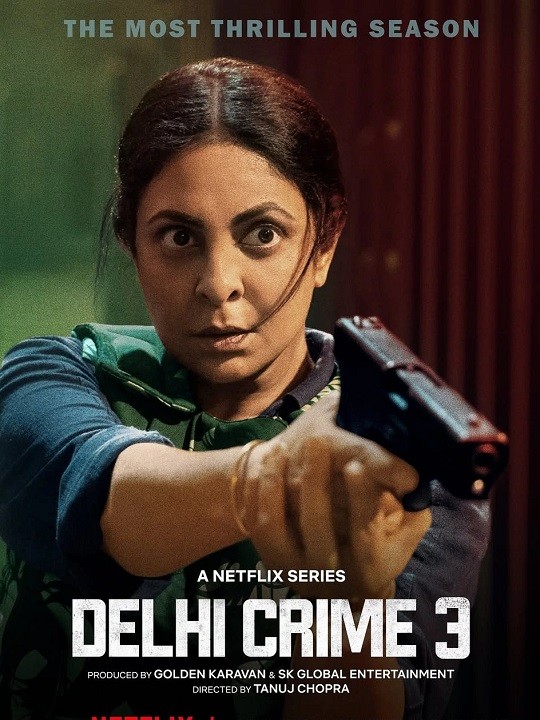

There is something about the city of Delhi that makes for an uncomfortable read – be it the grey skies developing a smog cover over the city, or the long and meandering roads that hold tales of darkness, or even the typifying male gaze that was turned into a horror genre of its own in the show Khauf. From the air to the streets, the city holds a distinction of an underbelly within its surface levels, at times that does go on to overpower streaks of positivity with respect to the food or even the helpfulness of the people. In that regard, the third season of Delhi Crime (aka Delhi Crime 3) struggles, given that it strays away from the ambience that once formulated a terrifying world in its previous two seasons. The snapshots of the city are fleeting, almost making it a secomdary character on a show that has a low screentime while being continuously pushed at the back. The idea of navigating through other cities from Silchar to Rohtak to Surat along with Delhi, convoluted the drama to an extent wherein the grim texture of Delhi does go slightly missing in an outing that felt decently engaging but a definite downgrade from its earlier seasons.
Written by Tanuj Chopra, Mayank Tewari, Michael Hogan, Anu Singh Choudhary, Shubhra Swarup and Apoorva Bakshi, the third season of Delhi Crime focuses on the real life incident of Baby Falak in 2012, wherein the world witnessed a horrifying image of a baby with a disfigured face being treated at the AIIMS Hospital in Delhi. But surprisingly, the writing chooses to play it safe here, not quite investing enough time in the politics around the drama – something that was synonymous with the first two seasons of the show. Instead, the focus just remains on the investigation that formulates the crux of the show.
So you are reintroduced to DCP Vartika Chaturvedi (Shefali Shah) on a punishment posting in Assam, uncovering a link between the flesh trades that transpire in Rajasthan and Haryana while prompting her to shift base to Delhi again. Her team still remains intact – ACP Neeti (Rasika Dugal), Inspector Bhupendra (Rajesh Tailang), sub-inspectors Jairaj (Anuraag Arora) and Sudhir (Gopal Datt), and the moment of her return is a cause for a heartfelt reunion. At the same time, you also see a parallel investigation being carried out by Neeti that traces her to a baby being dropped off at the hospital. Interestingly, both the cases of Neeti and Vartika are linked to the kingpin Badi Didi (Huma Qureshi) who is known to carry out her flesh trade business with her partner Vijay (Sano Di Nesh).
One of the biggest letdowns of the writing remained the characterization, or the lack of it in this case. For instance, the empathetic gaze of the characters utilized here is often short-lived while not quite being followed up, or rather spilt in their personal lives. In fact apart from the character of Neeti who is undergoing a divorce, you don’t really get a trace of the personal life of any of the other characters. Even the moments of altercation between Vartika and her husband cum hot-shot cop is short-lived, briefly touching upon the invisible privilege of the latter while never quite indulging in anything substantial. Even with the character of the main antagonist Badi Didi, the POV doesn’t shift to her side of the story that would double up as an origin story of becoming a kingpin. She almost seemed like an entrepreneur who would start her pitch with her clients with the words – ‘Hello Sharks’, where interestingly “sharks” can be a metaphor too. But when you don’t show her journey as a part of her pitch, the drama eventually lacks an emotional depth to the proceedings – immediately coming across as a tad too generic.
The investigation forms the heart of the show here, and to give credit where due – the understated tone of the drama drives the narrative here. I liked how the tone wasn’t compromised into something more palatable to a larger demographic, thereby automatically doubling up on the engagement factor. In fact, it wouldn’t be wrong to claim that it was this tone of understated seriousness that eventually helped the drama to be watchable at the end of the day. The coherence in the drama remains a key virtue at the start too, simply because the threads don’t seem to be fragmented even when the arrests begin to transpire. So despite the drama being devoid of any real twists and turns, it still felt engaging – particularly given how one arrest leads to another at the start.
The issue though arises when the writing chooses to wrap itself around in knots – even while choosing to branch out into twin investigations, one being led towards the identity of the mother whose child is admitted in the ICU, and second being the identity of personnel behind the hit order issued on one of the deceased. The larger picture still hints towards the flesh trade and bridal trafficking, but it felt kind of superficial on how straight the path was. When police officers land exactly where the culprit is staged, you do know that there is convenience in the writing that is laced with generic tropes. Occasionally, you are privy to some emotions along the way – like a character breaking down while narrating the guilt of not being able to tell her child about her intentions of selling her (given that she is dead). But then again the pace of the show dictates the shots here, abruptly cutting the emotions midway through.
The events continue to remain watchable on the back of some of the antics of the characters, even though characters are named only for them to appear in the next scene and disappear, consequently. Again, the events are not bad but you do expect a little depth from a show like Delhi Crime – as opposed to being witness to stray events like Vartika having a foreigner named London as her informer, or an officer randomly tripping at the gate of his room while spilling coffee onto his work monitors. Luckily, the understated tone of the drama does paper over these cracks, so much so that the drama is competent. This, despite the underwhelming climax that doesn’t fully commit to a face-off, coming across as just about decent. But I would be first to admit that I expected more depth that was really missing in a season that marked a significant downgrade of sorts.
The dialogues go well with the understated nature of the drama, but at times I did feel that the lines were too curated. For instance in a scene when a character asks ‘Mujhme Kya Dikhta Hai?’ (What do you see in me?), the reply that she gets is ‘Umeed’ (Hope). There are similar stray moments like these that briefly take you out of the scene, simply because they deviate from the realistic tone of the drama. A similar scene in the early seasons could have been crafted with the character just crying away, even as the camera would pan to the other character – without any exchange of lines. Therein lies the difference!
The BGM by Ceiri Torjussen is understated and does enough to elevate the impact of various scenes. The cinematography by Johan Aidt and Eric Wunder Lin remains a bit of a mixed bag. While the real locations add depth to the prodeedings, the tension isn’t really built-up courtsey a long shot in the opening sequence whereas the camera needed to be closer to the characters. Also, the extreme closeups of various characters did feel slightly repetitive while doing nothing really to elevate the traits of the characters, apart from the regular broad strokes in play. That said, the production design does add the much required depth in the drama, particularly with the interiors of walls with paint being peeled off. The editing pattern employed by Antara Lahiri, Manas Mittal and Parikshit Jha is taut and sharp, but at times it felt too taut for my liking. I almost wished to pause and soak in the moment, as opposed to going for a mad goldrush from one scene to another. And more than the editors, this does seem like a Netflix problem, given the want to drive pacy narratives as a barter for the slow burns that are typically filled with emotions.
The performances are pretty good here despite not all characters having the required arcs to play with. Denzil Smith as Vishal, Aakash Dahiya as Devinder and Yashaswini Dayana as Chandni have their moments to shine here, despite the writing not quite allowing these characters to add depth to the principal cast. Kelly Dorji as John is intimidating and does a good job even though I wished for a little more screentime from him. Suman Patel as Shabnam is phenomenal and she uses her expressions to convey her angst beautifully. Celesti Bairagey as Sonam is assertive (although with a superficial Math trait that circles back at the end), while managing to hold onto her own. Aditi Subedi as Khushi is such a phenomenal performer here who uses her eyes to express her guilt and regret.
Anuraag Arora as Jairag is natural to the core, and it immediately reflects in his body language, demeanor and one-liners here. Sidharth Bhardwaaj as Subhash, Namash Bhardwaj as Ashutosh and Gopal Datt as Sudhir are competent despite a limited screentime tagged to each one of them. Jaya Bhattacharya as Vimla is understated while exuding of an empathetic gaze that adds a little depth to her character, and her performance. Sano Di Nesh as Vijay is threatening while fairly managing to impress here.
Yukti Thareja as ASI Simran is outstanding to the core, from her Haryanvi dialect to her body language, she aces it all. In another world, her traits remained similar to Neeti (even as Neeti would then assume the mantle of Vartika), and the warmth just reflects in her understated act wherein Yukti is phenomenal. Rajesh Tailang as Bhupendra is sincere and earnest while doing a good job, although the (written) character lacked depth this time around. Mita Vasisht as Kalyani is in crackling form here despite an underwritten character. Anshumaan Pushkar as Rahul is once again in top form here, while managing to impress. Sayani Gupta as Kusum essays her role with a lot of conviction, and that makes for a remarkable act.
Rasika Dugal as ACP Neeti Singh is understated but supremely assertive with her antics, even while bringing a suppressed flair to her character. The vulnerability that she touches upon is wonderful to witness, even while sharing a heartfelt bond with a new protege. The writing doesn’t always do justice to her character, but Rasika still manages to leave a lasting impression. The same can be said for Huma Qureshi who is on a bit of a roll lately, with three releases in as many weeks. As Badi Didi aka Meena, she is a delight to witness here – subtly infuriating with her antics while possessing a chilling presence onscreen. She was phenomenal to witness here.
Shefali Shah as DCP Vartika Chaturvedi has a calming presence here – often shown to be quietly motivating her team members without losing her cool once. In many ways, she is like a shock absorber, imbibing all the external negativity while being rational and righteous at the same time. All of these traits are put forth in a performance that continues to remain stellar through the third season of the show. She is brilliant while maintaining a sense of dignity and posture that is filled with grace.
The third season of Delhi Crime is a fairly engaging outing with strong performances that makes for a decent watch. But I cannot discount the fact that this remains a bit of a downgrade from the previous seasons that had so much more emotional depth to the characters and the world. In other words, is this season watchable? – Yes, it is. Did I expect more from it? – Yes, again. Available on Netflix.