

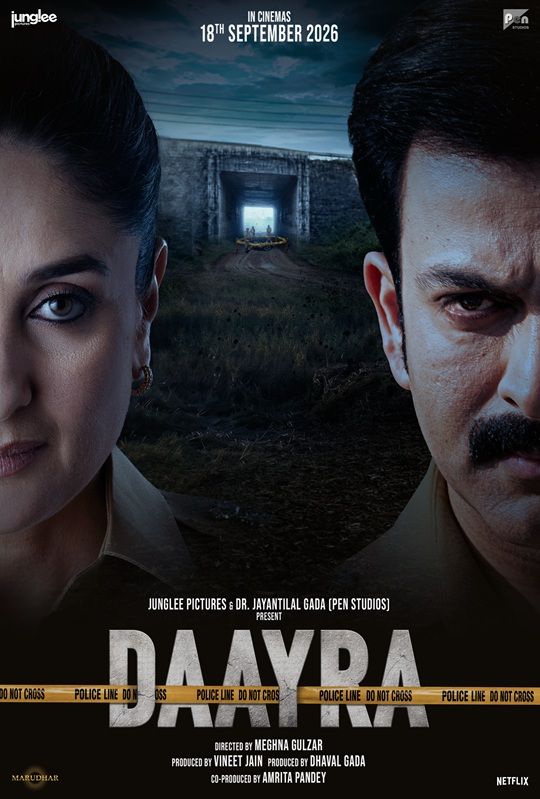
There are two fleeting images at the start of the new Hindi film Daayra that kick start the narrative. One involving an extensive celebration that transpires following the encounter of ‘perpetrators’ for a heinous crime by top cop DCP Raman (Prithviraj Sukumaran) – who is given a heroic welcome. But even in the moment, the mood fleetingly softens when the camera pans on the family of the victim – comprising of a mother and her son, who remain secluded and far away from the ongoing celebrations transpiring. The soul of the film is stationed between these two moments – one involving the ‘swanky’ idea of justice including a media trial that would be celebrated in the eyes of the people, and the other being that of reality that transpires; the lingering feeling of loss that is at times worsened in the wake of a rotting legal and law and order system.
Ironically, one look at DCP Ajooni Kohli (Kareena Kapoor Khan) and you get a glimpse of her privilege too. Being the daughter of a judge, she also carries a hint of privilege and idealism as far as the concept of a legal system functions in her mind. This is in a sharp contrast to the ground level realities that her counterpart DCP Raman is subjected to – thereby ably forming the basis of an interesting dynamic in the mix, that of a cop vs cop, or more specifically a yin and yang approach to the same legal problem in question.
Written by Meghna Gulzar, Yash Keswani, and Sima Agarwal, Daayra can immediately be classified as a companion piece to Talvar (2015) – particularly with respect to the ambiguity it aspires to tackle through its characters and a central incident that has unfolded. The connecting tissue remains that of a heinous crime that has transpired, eventually leading to the murder of Ragini (Pragati Mishra). But unlike Talvar that used the Rashomon effect to define its whodunnit template, the battle here is an ideological one between the two protagonists. So when DCP Raman finds himself in the midst of a human rights violation, the SIT inquiry is carried out by DCP Ajooni – in order to piece together the events of the crime, and its aftermath, allowing the structure of the narrative to be non-linear.
The writing ably offers a faint commentary on the prevalence of patriarchy. And it all starts in the Pujari household, wherein Ragini’s brother taunts her to fetch his spectacles from an optician shop, even if it would mean that an exhausted Ragini would have to make a trip once again towards her office in the wee hours of the evening (of course and event which would later translate into guilt). But when she suddenly goes missing following a tense phone call, the gaze shifts towards Ragini’s mother Parvati (Kshitee Jog), and her quest to locate her – an immediate conflict that makes her jostle between police stations at night.
And this is also when the commentary on the crumbling law and order situation becomes more pronounced – even when the senior inspector refuses to write an FIR, callously citing on how ‘most’ missing cases like these resolve on their own, or even nit-picking formalities to deny any paperwork. Ironically in a separate instance that also marks the turning point in the narrative, a hapless Parvati painfully tells a character on how her daughter’s death isn’t the ending, but just the start of the turmoil – a direct commentary on the legal battle that she would have to pursue in order to get any semblance of justice in the court of law.
The writing subverts the ongoing police procedural with regular bouts of bias that exist within the system. So whilst the tone remains gritty with the ongoing investigations and police procedurals in play, the writing dares to highlight the complexities of the case by addressing the dilemma of juvenile justice. Given that one of the perpetrators was below the age of 18, the subtext highlights the rigidity of the justice system in many ways – offering a contrasting picture of the adult crime while following it up with the argument of lower implications for the said accused. And interestingly, both the protagonists find themselves at the opposite ends of this argument – with one of them even tweaking the ‘ document proofs’ of the perpetrator in order to justify his action.
The immersive nature of the narrative is often mounted on crime scene simulations, even though the SIT investigation underway isn’t always impactful. And much of it has got to do with the predictability of the drama, despite the fact that the actual nature of the crime is meticulously reconstructed in hindsight. As a result, the cop vs cop cat-and-mouse game isn’t always enticing – often being less impactful than the events around the actual crime.
But my smaller gripe with the narrative was during its final act, that gently flirted with the idea of a confrontational face-off between the two protagonists. The open ending isn’t the problem, the abrupt nature of the proceedings is. I remember watching a similar ending in a film like Talvar (2015), and thinking of it for days. But the final blow is largely non-existent – and much of it had to do with the drama weighing in on one side of the argument, a little more than the other.
And even if I were to give that a pass, my issue with the underwhelming final act had its roots with the characterization of DCP Raman – particularly the moralistic stand that is extended to his persona, something that eventually diluted the ambiguity of the drama. The end result being that the drama wasn’t as ambiguious with its own morality than what it intended to be. But nevertheless, the screenplay is pretty well written and makes for a gritty watch.
The dialogues subvert much of the commentary of the drama with regards to the law and order, and legality of the system, whilst maintaining an emotionally heavy undertone in the narrative. And this feature also grounds the narrative in reality. The BGM doesn’t overpower the narrative at any point, allowing the drama to take centerstage – while the notes gently aide the narrative in elevating the emotional beats of the narrative.
The cinematography uses hues of grey to construct the drama – often being symbolic of the ingrained ambiguity in the narrative. The frames also play a part in building the levels of tension in the narrative, particularly during the police procedural scenes that evoke a sense of urgency. And even the emotional vulnerability of a few of the characters is ably captured through the frames, that allow you to invest in the gritty nature of the proceedings.
The editing pattern is largely sharp, ably holding the narrative together. It may have been a tricky proposition to execute a non-linear narrative in times when most films wear the fabric of a reel. But the intercutting timelines along with the intercutting crime scenes are wonderfully interjected, while leaving a desired impact in the narrative barring a few moments of lag in the second hour.
The costumes by Karishma Sharma wonderfully ground the narrative in reality, by stripping off the glamourized swagger of the cops’ attire – instead opting for muted variants to give the film a realistic look. This included a more corporate attire of DCP Ajooni – a small detail that would be attributed to her authoritarian position without giving her a masculine blueprint or a female-cop stereotype.
Director Meghna Gulzar meticulously crafts a gritty police procedural while opting for a realistic approach to her world of crime and justice. There is a deliberate attempt at initiating a conversation centered around some rather uncomfortable questions that had me invested in the narrative. And whilst her direction isn’t as sharp as compared to her brilliant outing in Talvar (the comparisons will be imminent), deftly faltering in the ambiguities of the narrative (given how the drama leans on one end a little more at the end) – there is definite purpose to her craft that creates an absorbing ambience in the wake of grounded storytelling. In other words, the direction is purposeful and quite commendable here.
The performances are pretty good by the members of the cast. Aarti Desai and Anuja Sathe have their moments to shine, despite the writing never allowing each of their characters to bloom. The likes of Sandesh Kulkarni as Head Constable Vasu, Saksham Dayma as Inspector Daya, and Manoj Sharma as Constable Prasad Nayar offer realistic and grounded portrayals of their respective characters that was superb to witness. Ram Diwakar as Raju, Aditya Kumar as Mastan, Abdul Mani as Mani, and Ashutosh Kumar Gupta as Babloo will make your blood boil with their antics – a sign that each one of them have their moments to shine. Trupti Khamkar as SI Jyoti and Ajeet Singh Pallawat are natural to the core, and both of them deliver wonderfully understated performances. Upendra Chauhan as Vishal and Ipshita Chakraborty Singh as Aarti are top-notch here, while putting forth solid acts along the way.
Kanwaljit Singh as Judge Kohli remains sincere and earnest with offering an interesting extension of privilege to the character of DCP Ajooni (his daughter). Biswapati Sarkar as Commisionar Prakash is wonderfully understated with partially calculative traits that define his persona. Brij Bhushan Shukla as Inspector Bala is terrific to witness here, and his antics have to ability to successfully infuriate the viewers. Jitendra Joshi as Inspector Karad is dependable, and he delivers a grounded performance that is impressive through and through.
Bhavesh Babani delivers a subtly gut-wrenching performance that is laced with guilt. Pragati Mishra as Ragini is outstanding to witness here, symbolizing pain and agony through an assured and painfully heart-wrenching act. Kshitee Jog as Parvati delivers one of the performances of the film. The amount of pain that she portrays through her expressive eyes and body language is immensely commendable, allowing you space to feel every beat of her character.
Kareena Kapoor Khan as DCP Ajooni offers a calming, realistic outlook to her character that is privileged in many ways. Tasked with investigating her own colleagues, she anchors her performance in a quiet, unyielding righteousness rather than aggressive outbursts. And yet her dilemma at the end is what formulates the internal conflict of her character that is dipped in the reality of her world – something that increasingly remains flawed. She was pretty good to witness here.
Prithviraj Sukumaran as DCP Raman essays his character not as a simple hero, but as a rigid man who is battling his own set of battles with respect to his morals and actions. It is a sharp, powerful act that generates a lot of the film’s early friction without ever needing to lean on loud dialogue or exaggerated heroics. In other words, he delivers a commanding performance that is assured in every way!
Despite faltering toward the end with an abrupt and underwhelming finale, Daayra is a gritty police procedural drama that does enough to keep you invested in its narrative. While the narrative deftly leans toward a particular side while trying to handle its ambiguous subject matter, the writing remains understated yet subtly powerful. Its commentary effectively spotlights a crumbling legal and law enforcement infrastructure, which, when coupled with compelling performances, transforms this flawed drama into a profound and thought-provoking watch. Available in a theatre near you.


