

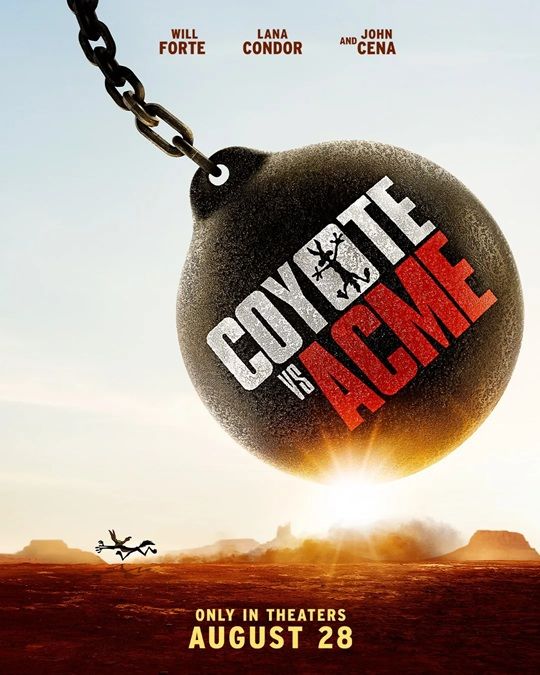
It is interesting on how the broader themes of capitalism in the new English film Coyote Vs Acme blend in with a heavy meta-commentary of the real world, particularly given how Warner Brothers Discovery had initially canned this film to waive off their tax (only to be miraculously rescued by Ketchup Entertainment). In that sense, this remained a David Vs Goliath narrative that blurred the boundaries between real and reel. It is also interesting on how it is Coyote (a famous character from Looney Tunes) that becomes the face of consumerism here. My mind immediately wandered to the poor common man of the famous Indian show ‘Office Office’ (2001), who would often stumble on government offices in order to get his job done. The setting and the characterization though remain slightly different here – with the government offices replaced by the evil capitalist corporation called ‘Acme’, even as Coyote who was the erstwhile poster boy of anti-gravity and unperturbed mishaps during his infamous face-offs with his immortal foe The Road-Runner, soon finds himself in a role reversal of sorts in the eyes of the viewer.
Written by James Gunn, Jeremy Slater, and Samy Burch, there is a whiff of nostalgia while witnessing the several characters from Looney Tunes gracing the narrative here. Be it the ‘Wile.E’ dynamic between Coyote and The Road-Runner that had formed an integral part of my childhood, or the mad-hatter traits of Daffy Duck and Bugs Bunny that had me smiling from ear to ear, or even the cutsie mercenary act of the cutsie Tweety Bird that sprinkled moments of laughter in the narrative – this felt like nostalgia done right, even as I reminisced my time of tuning in to my favourite cartoon characters immediately after school. And yet even in this capacity, the writing wished to address a larger issue in a template that epitomized the underdog.
The characterization does its bit in elevating the stature of the drama here. For instance, the protagonist Coyote isn’t a saint himself, in fact – he is an anti-hero that frequently devises plans to trap and feast on The Roadrunner. The latter remains an immortal figure, being unaffected by any antics of the former, who in-turn is known to be a regular customer of the ‘faulty’ Acme products that may seem to result in funny outcomes for the viewers, often at the cost of the downfall of the protagonist, literally speaking. And hence, the idea of suing the evil corporate is what forms the core premise here, even as Coyote approaches Kevin Avery (Will Forte), who is the owner of a humble, personal injury law firm.
It is interesting on how the corporate here is depicted as a faceless temple of greed in an inescapable mode of monopoly. If it were a Hindi film villain from the 70s, it would be Gabbar from Sholay (1975) – a character so evil and so powerful that he would stop at nothing. In 2026, if Acme was a person – he would be a corporate honcho, often working hand-in-glove with the government on a pretext of serving people, but instead capitalizing on his profits at the cost of human lives. Now who could that possibly be in the real world – making empty promises in single echo chambers through reels that seem increasingly false and lunatic? Your guess is as good as mine.
The narrative follows the standard beats of the legal drama – that includes an out of court settlement by the defending lawyer Buddy (John Cena; ironic with the name along with a meta-commentary on the goodness of the character – that cannot be ‘seen’), a trust deficit between Kevin and his client, a court of law that seems to be increasingly compromised, a discrete project underway by the name of Sisyphus (ironically linked to Coyote who like Sisyphus, pushes the boulder up the hill, only to watch it roll back on himself), an underground operative in the form of a ‘surprise’ whistleblower (hint : ehhhh whatsup Doc), and a plan to supercede or even eliminate the sole witness in the form of The Roadrunner.
And yet, there are two ways that the writing coaxes you to guage the exploitation in play. One involves the invisible lines of hierarchy in the form of the citizens of this world – even as second-class citizens (read : the middle class) like Coyote have to bear the brunt of the corporates, knowingly or unknowingly. And the other stance being that laced with a meta-commentary – on how the Looney Tunes figures had to take up a fight against an evil capitalist like Warner Brothers Discovery, wherein the value of the art and the artists is purely reduced to financial assets that are perishable in nature. In an alternate world, this could also be a commentary on carrying out tests on animals, even as humans would continue to be oblivious, deranged and detached to the harsh realities of the world.
The proceedings are entertaining and delightfully funny, even as the larger messaging doesn’t overpower the narrative while still continuing to treat it as a film for kids and young adults. Even through the standard beats of the narrative, the timely usage of some famous characters and figures from Looney Tunes had me immensely invested in the proceedings. This, while they doubled up as some interesting nostalgia baits along the way. There is a hint of an emotional core in the form of an unexpected friendship that laces the narrative at the end, without losing sight of the core themes in the narrative. The end result is a roller coaster ride of nostalgia that is rather poignant in today’s times, even as it had me questioning the realities of life – are these ‘Toons’ Looney or humanity in general featuring powerful capitalists who would stop at nothing in destroying this beautiful world. Worth a ponder, I’d tell you!
The dialogues have timely tinges of the essence that the Looney Tunes characters brought back in the day, even while ably contributing to the comedic (read: Looney) elements in the narrative. The BGM is deftly reminiscent of the iconic Looney Tunes symphony, something that had me smiling from ear to ear. This, while competently incorporating a score that would immediately jog your memory to the good ol’ days. The animation is outstanding to witness here, almost being identical to the hand-drawn images of the characters from back in the day. This, even as the cinematography comprises of frames that maintain the intensity of the drama. The editing pattern is crisp and sharp, something that not only holds the narrative together, but doesn’t allow the drama to overstay its welcome. This, without compromising on the varied tone of the proceedings that oscillates between ‘Looney’ and ‘Intense’.
Director Dave Green does a marvellous job in tapping into the nostalgia here through his characters, and their antics. And while that is also enough to serve the purpose, the focus remains on a larger and relevant topic of a fight against capitalism – a 21st century term coined for the corporatea who are known to indirectly mistreat people in exchange for profits. The direction never loses sight of this core conflict, even while resorting to some unhinged entertainment and ticklish comedy along the way. The direction is spectacular here, something that subverted the nostalgia with topical moments of relevancy!
The performances are pretty good by the members of the cast. The likes of Luis Guzman as Judge Troppogrosso has his moments to shine. Lana Condor as Paige and Tone Bell as Sal are pretty impressive in their respective roles. John Cena as Buddy is competent while putting forth a nicely measured act with bouts of dramatization. Will Forte as Kevin is sincere and earnest while managing to hold his own here. His unforced antics cut through his bouts of sincerity, something that offers a different dimension to his character in an enjoyable context.
Jim Cummings as the voice of Tasmanian Devil is a delight to witness here. Candi Milo as the voice of Granny, Miss Prissy and Witch Hazel is tremendous in the truest sense. Eric Bauza as the iconic voice behind the characters Bugs Bunny, Daffy Duck, Foghorn Leghorn, Porky Pig, Tweety, The Road Runner, Elmer Fudd and many more, is excellent and truly a bait to tap into the nostalgia here, something that took me back to my childhood.
Coyote vs. Acme offers a relevant and sharp commentary on the fight against corporate capitalism, delivering its message through enjoyable bouts of clever humour and a narrative device that acts as a beautifully executed piece of nostalgic bait. The story brilliantly mirrors the real-life battle that the film itself had to endure against a cold corporate monopoly, creating a meta-narrative that resonates deeply with modern audiences. By seamlessly incorporating your most beloved childhood cartoon characters into a high-stakes legal struggle, the film blends live-action and classic animation into an excellent drama laced with nostalgia, thereby making it both a thought-provoking watch and a heartwarming journey that will instantly transport you back to your childhood. Available in a theatre near you (in USA), and Highly Recommended!


