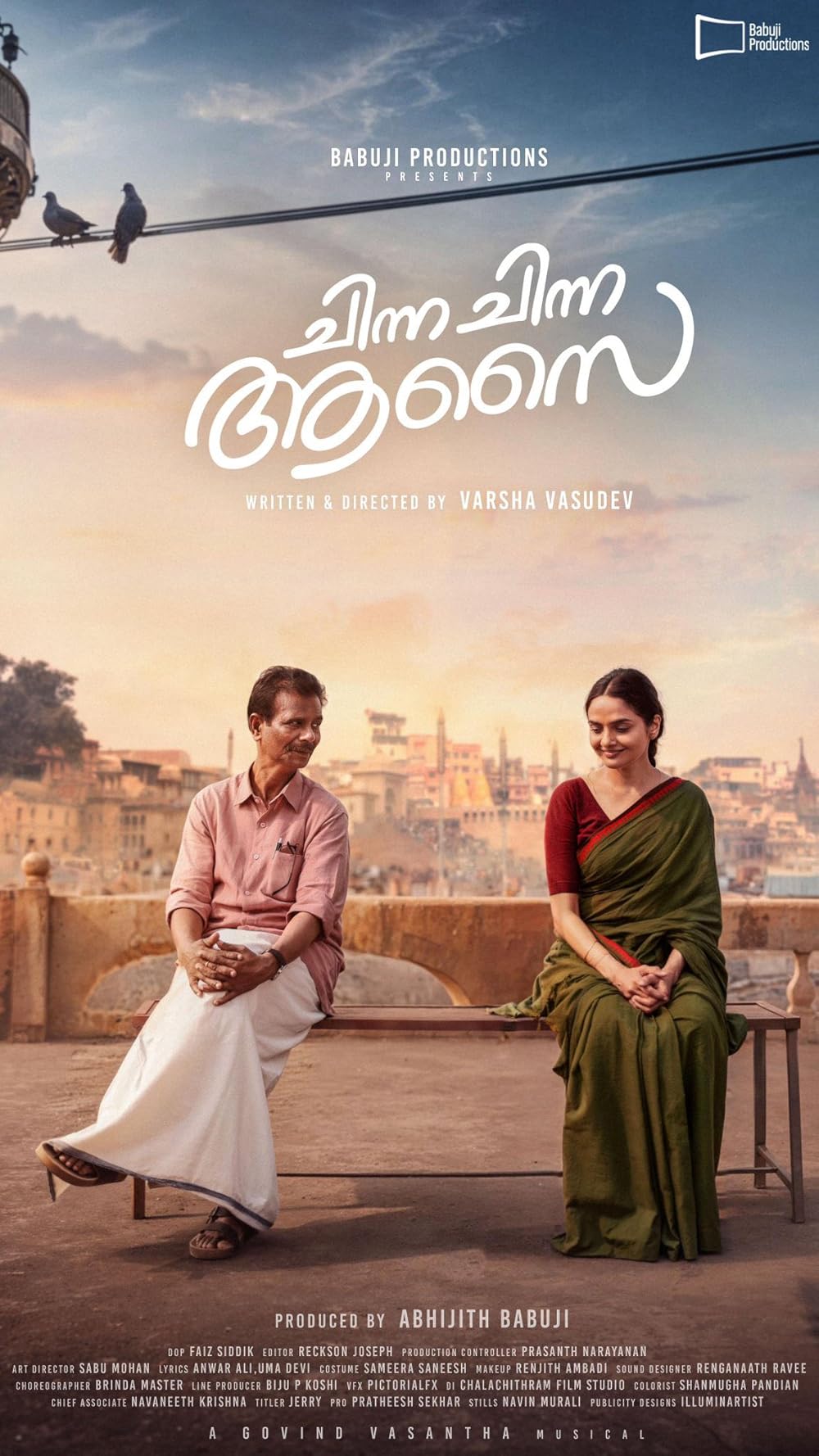

One of the key traits that connects the two protagonists in the Malayalam film Chinna Chinna Aasai (a meta shoutout to a song from Roja (1994); also co-starring Madhoo), is loneliness. When you are first introduced to Leela (Madhoo) and Madhavan (Indrans), there is a streak of loneliness that has plagued their lives. And yet, their response to loneliness is very different. Madhavan is known to be a free-spirited person, interacting with everyone around him, whereas Leela remains the reserved one – often keeping to herself, even when she has separated from her touring group following a theft. Ironically, it is the setting of the beautiful ghats of Varanasi that completes the triangle in their lives – a place that is often regarded as the final destination of people before the soul departs, or a place that is equivalent of attaining salvation. For Madhavan, it remains a way of getting accustomed to companionship for probably the first time after his wife’s death. For Leela, it remains a way of spending that one day comprising of infinite moments for herself, particularly given the hardships that she has had to endure through her relationship and family dynamics. And it is fate that brings these two protagonists together, much like the one in a franchise like Before Sunrise – however short-lived it may be!
Written by Varsha Vasudev, Chinna Chinna Aasai remains true to its title that literally translates into ‘Small Small Moments’, something that remains true even with regards to the first encounter between the two protagonists. She is quiet and ‘lost’, he steps in to volunteer as her ‘guide’ almost like a good samaritan, helping her ‘find’ her way back to her group. In that sense, the dynamic is stationed around the lost and found template – except that you aren’t exactly sure of either until you are acquainted with the characters.
The dynamic between the two protagonists begins with a whiff of awkwardness, even as you notice a subdued Leela requesting her new acquaintance to buy her a lassi. When he also volunteers to buy her a bowl of mutton biryani, she reluctantly refuses, only for her to chomp off the pieces of mutton once he steps out. In another instance, you see the duo briefly bonding over the purchase of a Banarasi Saree, only for the awkwardness to creep in when Madhavan approaches Leela to don some jasmine in her hair. Later when she insists on an apology and he obliges, all is well again. In other words, these instances of awkwardness form the smaller precious moments that often leads to a sense of trust being built between the two characters.
The setting of the ghats play an important character in the mix, often being a quiet observant to their dynamic. And it remains an important medium to allow the viewers to acquaint to the characters and their traits too. This is because the calm and soothing terrain of the ghats offers a sharp contrast to the grief-stricken and turbulent lives of the protagonists in the mix. For Leela, it remained about living for others under the garb of societal expectations – finally finding a window of opportunity of living for herself. The setting remains a means of not only escapism but also a way for her lost soul being found – a trait that mirrors her actual situation of being lost on the ‘Ghats’ and ‘Life’.
This ‘lost and found’ trait extends to Madhavan as well, a gentle soul who has been a loner, living a quiet little life with his daughter Janki (Aparna Balamurali). In a brief scene, you notice his inhibitions of having to shift countries with his daughter, bearing his vulnerability to his fellow stranger. He isn’t as lonely as Leela, but the loss of a companion is what he finds in her – even if would remain a brief moment in his life. In a way, his free-spirited demeanor is a sharp contrast to her rigidity – almost doubling up as a catalyst in her journey of self discovery, while also being able to find his lost self along the way.
The smaller moments in the narrative extend from the walks on the ghats, to the quiet little rooftops, and from the narrow alleys of Varanasi to the beautiful boat rides on the Ganges, from a quiet little visit to an old age home, to the brief joys of dancing on the footsteps of the holy river. And each of these instances offer a hidden subtext of life, a metaphor that instantly took me to the exchanges between two characters in a film like Taste Of Cherry (1997). Even in these moments, there is a hint of freshness (if I were to ignore the brief disruptions of comedy infused in the narrative which felt rather needless), even as the duo visit a hotel room. The freshness isn’t in the intimacy given that their relationship is entirely platonic – it is the form of trust that completes the arc of their relationship from the early bouts of awkwardness.
There is an emotional buildup that culminates into a gut-wrenching finale, something that wasn’t entirely expected given how the setting itself is equated to salvation. But in hindsight, the serene journey itself felt like a cycle of life unfolding through a single day, with the smaller moments mirroring a cycle of life, death and rebirth within the stipulated time period – a profound and poignant thought that extends to the fate of the characters. And even in this space, the concept of ‘lost and found’ has an appropriate analogy – of losing someone at the cost of finding yourself, and finding someone at the cost of losing yourself. The paradox is evident along with streaks of grief and salvation that form vital ploys in the narrative. The screenplay is wonderful to witness here.
The one area of improvement for me was the dialogue writing, wherein there wasn’t a need to lay out every little thought out in words. Lines like the characters questioning the purpose of life was already being communicated in its subtext, and despite the heartfelt tone of the lines – the outspoken nature of the dialogues felt a bit like spoonfeeding details to the viewers. On the flip side, I liked the cross cultural backdrop that was reflective through the lines that spanned from Malayalam to Tamil and Hindi. The music (featuring beautiful lyrics by Varun Grover) and BGM remain serene additions to the screenplay, almost grounding the narrative in the spiritual tropes of the setting, while adding profound moments of poignancy in the narrative.
The cinematography comprises of frames that often isolate the protagonists from the setting, a trait that felt quite meditative in many ways. Yes, the high frame rate may not have been needed given its leisurely setting, but the frames helped in immersing me into the intersecting lives of the protagonists in the most meditative way possible. On a personal level, it helped me absorb and be emotionally invested in their journeys really well. The editing pattern allows the conversations to brew seamlessly without interruptions, something that in-turn plays a role in investing you in the characters and their emotions.
Director Varsha Vasudev offers some poignant sensibilities to drive the narrative here. I liked her idea of creating a contrast between the setting and the characters in it. Her focus remains on a strong emotional core that riddles the brewing conversations, offering a way of poignancy despite at times going slightly overboard with the lines. There is definitely a finesse to her craft, allowing you space to get acquainted to its characters – something that adds to the immersive tone that she chooses to employ. And the profoundly meditative finale is enough to fill you up with emotions – in a drama that can be termed as a coming of age tale or the one of self discovery. Either way, the direction remain excellent here!
The performances are largely wonderful by the members of the cast. The only actor out of place was Thambi Ramaiah whose track itself wasn’t needed, given that the comedy here had no reason to exist. Apart from that, there are smaller contributions from Jaffer Sadiq as Shetty, Vishnu Agasthya, and Kaali Venkat – each of whom deliver poignant performances that ably contribute to the fabric of the drama. Aparna Balamurali as Janaki is wonderfully understated, while offering a sense of groundedness to the narrative.
The drama though belongs to Madhoo as Leela and Indrans as Madhavan, both of whom are exceptional to witness. The former offers a restrained act that is filled with smaller gestures of unsurety, and anxiety that defines her character. The idea of finally having to live for oneself is frightening to begin with, wherein one could easily be lost – a trait that was wonderfully tapped into here by her. And yet, her arc is heartfelt symbolizing a circle of life that coincides with her late blooming persona – something that is beautifully expressed by her.
Indrans as Madhavan remains such a gentle and an affable character, laced with dignity and warmth that it is hard not to be wooed by his charm. His free-spirited nature is wonderfully christened in act that is equally sincere and earnest in nature, offering heartfelt expressions and gestures to further create an aura of sincerity. He is terrific with his body language and expressions, something that is comforting and genuine in many ways, something that sums up his act that was genuinely brilliant to witness.
Featuring heartfelt performances, Chinna Chinna Aasai is a meditative conversational drama that achieves immersive poignancy through its beautifully realized characters and evocative setting. While the narrative occasionally leans into over-explaining its characters’ internal dialogues, the underlying drama remains genuinely palpable, masterfully exploring a poignant “lost and found” thematic arc. This rich emotional resonance, paired with atmospheric world-building, firmly elevates the film into a deeply affecting and worthwhile viewing experience. Available on JioHotstar.