

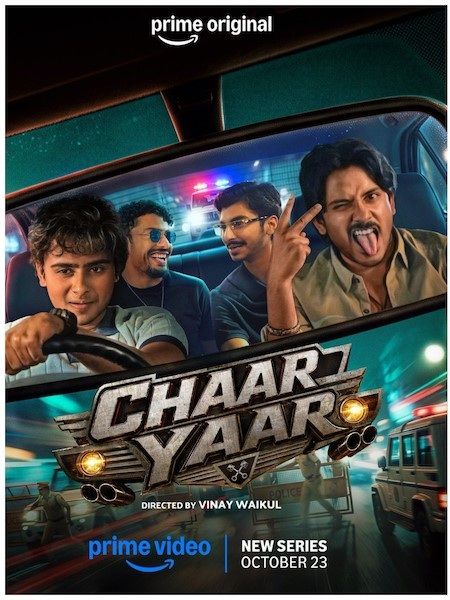
There is something very likeable about the new Hindi show Chaar Yaar, that wishes to subvert itself as a buddy comedy amidst a gangster set up. There are passing pop-cultural references to Dil Chahta Hai (2001) and Satya (1998), with the drama being staged in the early 2000s – an accurate depiction of the wavelength, it aspires to engage with. The metaphor to the friendship is equated to the four tyres of a car – something that keeps the wheels rolling when all of them are functional and sticking together. The irony remains on how each of the four protagonists – Jay (Prayrak Mehta), Tony (Saqib Ayub), Sahil (Purav Jha), and Sameer (Naman Jain), are notorious car thieves with entrepreneurial skills that feel straight out of TVF Pitchers. This, while they have to deal with other kinds of ‘sharks’ to survive! The problem with the show though is on how it isn’t content with being a buddy comedy with gangster undertones; it is ambitious and wants to take in a lot many characters along the way, make the show overstuffed, and then not know what to do with them. It is similar to you ordering your favourite food, and going on an over-eating spree – only for indigestion to kick in, something that would ruin the overall experience.
Written by Sambit Mishra, Hussain Zaidi, and Saurabh Sawant, the first season of Chaar Yaar follows a trajectory that recently seems to be playing out on loop – an engaging premise and a fun few episodes (or the first hour), followed by a repetitive and unceremonious second hour. That literally has been the story of the recent spate of releases that I have encountered, something that makes for a rather frustrating watch. The start though is promising, with each of the four protagonists that can be viewed as a single person – something on the lines of ‘Chaar Jism, Ek Jaan’. Keeping that in mind, Jay remains the brain of the group, while the others formulate the rest of the body (and no, nobody is a d*ck here).
There is a searing urgency employed in the writing when Jay’s girlfriend needs a sum of 10 lac rupees, surging the group of four together, even as they begin their tryst in the world of crime. Their financial support remains a notorious gangster Imtiaz (Sikandar Kher), who would soon become their underworld boss following his demand of stealing cars in order to return his money. Elsewhere, there is also a track involving a female cop Bhalerao (Sai Tamhankar) who is caught in a patriarchal web of intimidation and repression by her superiors led by the chauvinist Dilip Wankhede (Rajesh Tailang). And you do know that somewhere, these two worlds of carjacking and the law would coincide. The problem remains on how the writing doesn’t feel content with these set of dynamics, in-turn wanting to inject more life into an already lively premise.
The issue remains with the ambitious nature of the writing in trying to add a whole set of characters that don’t all significantly contribute to the plot, while invariably bloating its runtime. So you are introduced to Sharad Nagre (Chunkey Pandey) the kingpin of the drugs mafia in-turn cracking a deal with another kingpin Cocaine Kareem (Nassar), while treating his ambitious sidekick Babu (Dibyendu Bhattacharya) as well.. The latter doubles up as a trojan horse siding with the cops in an instance, while also discreetly working against his own clan – and pitting his people against each other. And a member of his clan Muthu (Bucks) remains his latest casualty, pitting him against Imtiaz.
The four guys here can well be perceived as the futuristic variants of the four protagonists – a plot point that never quite seems to circle back. In between. There is also a Bob-Biswas coded Maharashtrian couple who are serial killers, and a notorious gangster from UP who come and go, without quite having a say in the screenplay! And the personal lives of the four boys and their dynamics with their respective partners feel like an after thought.
The proceedings transition from a fun buddy comedy to a serious gangster drama, almost letting go of the naive synergy that did make the drama unique in the first place. There was a point in the narrative wherein the ‘wannabe-ness’ of the characters was amusing – be it Jay’s demeanor of a young Harshad Mehta, or Tony being a spin-off version of SRK’s character from Josh (2000), or even the ‘noob’ skillset of Sameer in trying to rob a car, or the playful existence of Sahil envisioning himself as Bhikhu Mhatre from Satya (1998). The playfulness of the characters almost felt reminiscent of a TVF show in a gangster setup – something that was refreshing to begin with.
But the show definitely dips in the second half, convoluting plot points that have no significant impact in the narrative. For instance, the introduction of the ex-boyfriend of Bhalerao, and making him her boss was a plot-point that didn’t exactly add him; particularly because his antics remained similar to a vilified character like Dilip. In all of this, the incompetence of the cops felt woefully out of place, particularly in an era where they did not have to worry about harmless ‘protestors’ plaguing the city.
The arc of the show can be determined through two shootouts – one at the halfway mark that also had nuggets of humour infused in the narrative. And the one at the end, that felt like a chaotic infusion of a Priyadarshan film – with all characters being stacked up at a single location, without a purpose. To top it, the level of convenience of the writing was appalling – characters are shot dead, but protagonists are left scot-free because they are buddies?? The reverse exponential graph of the screenplay is a case to be studied here, in a piece of writing that flattered to deceive while ending up being middling.
The dialogues have an imminent sense of humour that is engrained in the narrative, most of which refreshingly takes the form of a banter. And much of this streak cuts through the seriousness of the gangster genre, allowing the drama to be light and frothy – atleast in the first half of the show. The BGM does its bit in trying to maintain the levels of intrigue in the narrative, typically by employing a sound that is a familiar staple for gangsters films from the 90s and early 2000s. The sound of trumpets are a give away. The cinematography comprises of frames that have a contrived arc of their own – much like the arc of the writing. The frames allow you space to invest in the characters and indulge in the banter, before suddenly pulling out the plug and disconnecting you midway, from the drama. The shootout at the very end is so poorly staged, almost like everyone was in a hurry to wrap things up.
The editing pattern is also essentially about the two halves here – crisp and sharp in the first half, but bloated and straying in the second. The amount of lags in the second hour is appalling to say the least, even as repetitiveness did creep into the proceedings. Director Vinay Waikul successfully captures the initial refreshing vibe of a buddy gangster crime comedy, perfectly nailing the nostalgic, desperate world of four middle-class Mumbai friends thrust into the underworld. However, he loses the plot midway as the narrative skids off track under the weight of too many characters, moving parts and subplots. The show becomes repetitive and bloated, drowning its earnest performances in fluffy treatment and overextended drama that overstays its welcome. So overall, the direction remains a mixed bag!
The performances are wonderful by the members of the cast, despite the writing not fully justifying the individual arcs of the characters. Having said that, veterans like Paresh Ganatra, Manav Govil, Suresh Vishwakarma, Mohan Kapur and Pankaj Jha are wasted – never fully being allowed to contribute ably to the plot. Chunky Panday as Nagre is intimidating and quite a revelation, despite a limited screen time. Bucks as Muthu also offers some intimidating bouts to his persona, and he puts forth a commendable act. Kanikka Kapur, Kiran Khoje, Bhairvee Burad, Muskaan Chandra, and Surabhi Das are sincere and earnest with their performances – and each of them have their moments to shine.
Dibyendu Bhattacharya delivers a calculated performance as Babu Chauhan, bringing a distinct old-school Mumbai crime flavor to the screen. While the script limits the true menace of his character, his commands carry an effortless screen presence that anchors the chaotic criminal environment. His seasoned acting adds a layer of depth, proving that even within a formulaic gangster role, his quiet authority can captivate the audience completely.
Rajesh Tailang commands immense authority as Dilip Wankhede, a corrupt encounter specialist with a dubious history that keeps viewers on edge throughout the show. He portrays the lawman with a grim, uncompromising demeanor, effectively capturing the inner malice and absolute power wielded by dirty cops in early-2000s Mumbai. <span;>Sai Tamhankar shines brightly as Inspector Sumati Bhalerao, an honest cop fighting against an unfair system with a sharp, no-nonsense attitude that commands instant respect. Even though the screenplay occasionally limits her narrative arc, her screen presence remains incredibly compelling and elevates the typical police procedural tropes.
Sikandar Kher brings a compelling presence to the series as Imtiaz Engineer, the calculating underworld figure from whom the desperate protagonists borrow their initial funds. He plays the criminal operator with an understated composure, attempting to ground the high-stakes narrative with a sense of brewing tension. Even though the overcrowded subplots occasionally dilute the inherent menace expected of his prominent underworld character, his imposing stature makes an impression.
Naman Jain infuses Sameer Khilji with a highly mischievous, unpredictable streak that frequently invites trouble for the group. He utilizes his extensive acting experience to make Sameer both incredibly frustrating and deeply endearing, giving the audience plenty of excellent comic relief.
Saqib Ayub provides a vibrant, high-octane energy through his portrayal of Tony Gomes, capturing the essence of a relatable Mumbai boy. His witty delivery and sharp comic timing offer a refreshing breath of air amid intense underworld conflicts, keeping the overall tone balanced.
Purav Jha as Saahil Shaikh, an impulsive risk-taker chasing quick monetary success through high-stakes car thefts. Transitioning seamlessly from content creation, he showcases a natural and relaxed screen presence driven by high-energy acting and highly expressive performance choices. He was a treat to witness here.
Prayrak Mehta delivers a grounded and highly nuanced performance as Jay Gala, balancing the erratic impulses of his companions by serving as a logical presence. He handles both the lighthearted comedic moments and the sudden dramatic tonal shifts with impressive maturity, showcasing his versatile acting range. His steady contribution to the group dynamic ensures that the bonds of friendship remain believable and strong through every escalating twist.
Despite stellar performances, the first season of Chaar Yaar flatters to deceive. It shows promise initially by blending a vibrant friendship theme with a potent gangster drama and buddy-comedy elements. However, the show dips after the halfway mark due to an overstuffed narrative and bloated character roster, ultimately resulting in a middling watch. Available on Amazon Prime.


