

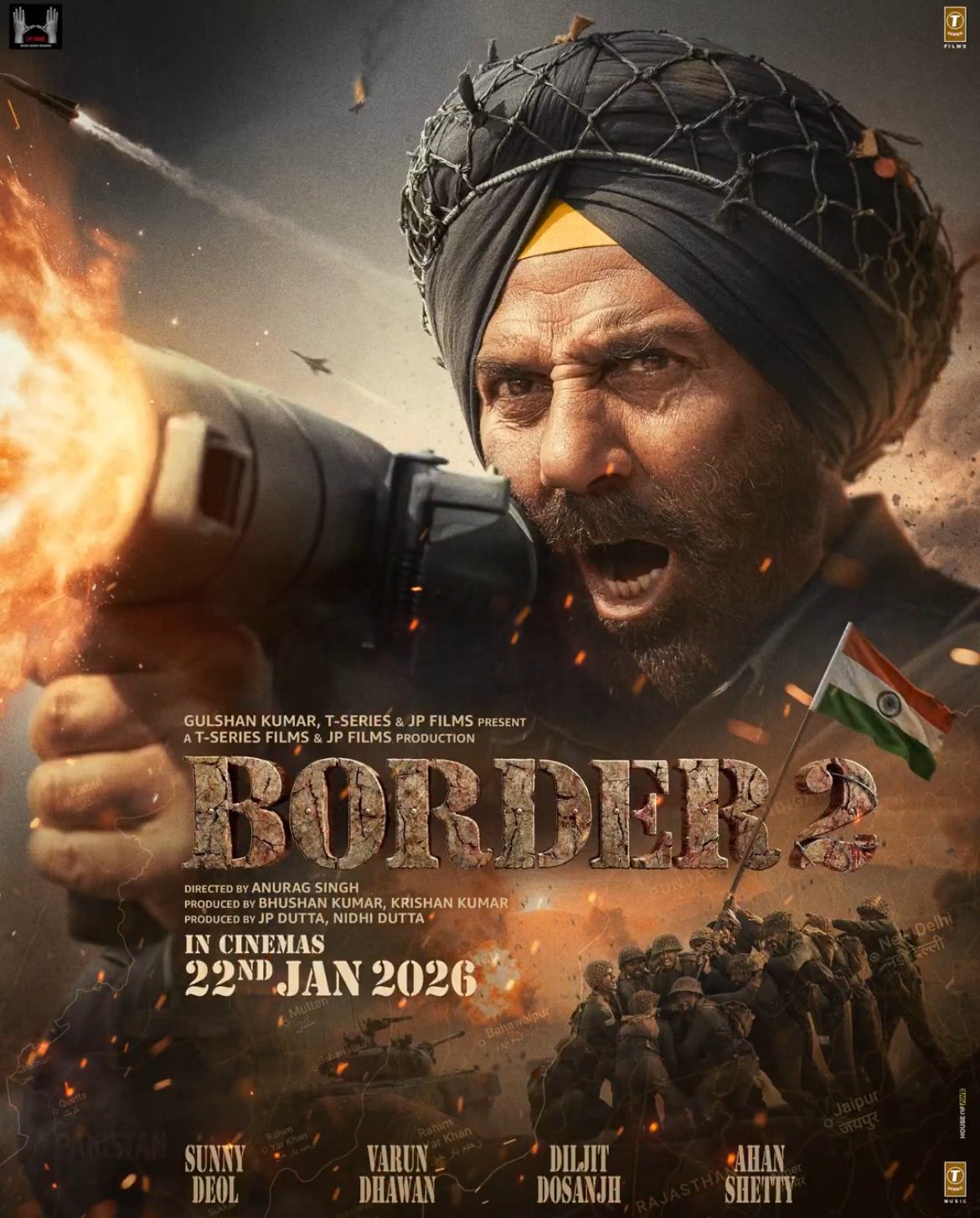
A distinct criticism that I had while watching the new Hindi film Border 2, was with respect to its structure. One of the reasons why Border (1997) remains my absolute favourite is because it chose to stay committed to a single battle that was fought between India and Pakistan in 1971. And by that I do mean that almost the entire film did unfold at a secluded location in Rajasthan, wherein all characters gathered for a showdown. There weren’t unnecessary cutaways (other than the flashbacks) that allowed a far more immersive experience to unfold onscreen, with the right kind of emotions gracing the occasion. I was literally a child back then, but I still remember sitting with by hands clasped to my chair while completely being engrossed with the emotions of the characters. Cut to 2026, and I would be lying if I was completely invested in the journey of every character. And much of it had to do with its scattered structure – a creative decision that chose to focus on different mediums of the 1971 Indo-Pak war including the Army, The Navy and the Airforce through its characters. In the same breath, I never was fully settled in the drama.
Written by Sumit Arora, Anurag Singh and Nidhi Dutta, the inconsistent tone is evident in the first hour of Border 2, even as every character namely Lt. Col. Fateh Singh (Sunny Deol), Major Hoshiar Singh Dahiya (Varun Dhawan), Lt Cdr M S Rawat (Ahan Shetty) and Fg Officer Nirmaljit Singh Sekhon (Diljit Dosanjh) gets a separate introduction. The timeline remains that of 1971 wherein tensions escalating on the eastern front have spread to the western front between India and Pakistan. In a scene, you see an infiltration bid being intercepted by the Indian Army, even whilst the Indian Navy and Airforce are kept on standby. The events are often choppy and co-exist in isolation, even whilst incorporating an extended flashback to focus on the individual journeys of these four characters almost decade ago. The choppy events wasn’t the core issue, the tone was!
The origin story of Hoshiar, Rawat and Sekhon almost felt like a mix of Lakshya (2004) and 3 Idiots (2009) given how there are forced bouts of comedy incorporated in the drama. This particular streak of tonal inconsistency is often represented in several Punjabi films that refuse to commit to the core emotions, whilst allowing deviations to creep in. So even from a character building perspective, all you really learn is that Hoshiar is a loner, Sekhon hates losing and Rawat completes the trio a la ‘Uncle Sam’ from Dil Chahta Hai (2001). There is a specific character arc in play in typical tongue in cheek style that sees the three boys overcome initial bouts of friction to truly become besties, with each dedicated segment being presented for their individual love lives until it is time to leave. Likewise, you also learn about Fateh Singh’s family including his son who wishes to serve the Indian army. There are plenty of foreshadows in play that allow you to predict the fate of individual characters. The emotions are somewhere sandwiched or rather buried beneath the needless comedy, but thankfully, they reach the surface in a few scenes.
Like last year’s 120 Bahadur, the drama follows a similar checklist as far as the humane story of the drama goes – a newly wed character longs for her husband to return soon, a mother gently wishes her son a goodbye, a pregnant wife reluctantly agrees to spend days without her better half, a daughter paints a picture for her daddy. The emotions are definitely in play here (and no doubt about that) but, the loud tone of the drama overhauls overshadows much of the emotions in the first half. On the positive side though, the heavily-charged up interval block sets the tone for a promising second hour, which threatened and threatened and threatened but didn’t quite land smoothly.
Given the trajectory of the drama, the comedic tones are done away with a heavy-hand of emotions in the battlefield which honestly does contribute to some beautiful moments (I won’t lie). Be it two soldiers discussing about the letters from their homes – with each letter bringing its shade of a good and bad news, or a sedate scene involving a soldier being committed to keeping the fire burning in a temple as a symbol of hope, or even emotions that pierce through another swift flashback. The drama feels most alive when the focus remains on some of these fleeting moments.
But the battle scenes don’t fully land, once again given the scattered structure of the narrative along with some technical flaws that were quite evident. The tonal inconsistency also made a comeback in these smaller moments, given how the natural tone was laced with chest-thumping emotions as opposed to building on the human emotions on the battleground. In simpler words, a final hour (in a 3 hour 19 minute film) was massy but scattered, and lacked the sensitivity of Border (1997) wherein most of the war had transpired at a single location. Yes once again, the emotions right at the fag end of the drama do land beautifully – but that was symbolic of the inconsistent wavelength of the war drama that frequently took me in and out of the proceedings, without allowing me to fully settle and invest in the characters.
While venturing into a film like Border 2, you have already signed up for the loud and high-pitched emotionally high dialogues laced with chest-thumping jingoism that would grace the screen. And in that regard, the film doesn’t disappoint. The music is pretty good with a handful of yesteryear’s numbers from Border (1997) being repackaged in the narrative year. But I was disappointed with the use of the song ‘Ae Jaate Huye Lamhon’, that felt half-baked and wasted despite being beautifully sung by Vishal Mishra. The emotions didn’t land as it had in the first film. ‘Sandese Aate Hain’ on the other hand, did score relatively better – despite it being a lesser version to the original. The BGM does its bit in heightening the intensity of war scenes, as also the emotionally core of the drama which is aided by the emotional notes.
The cinematography remains an interesting talking point in the film, given how some of the frames really create a sense of tension here – be it a camera placed inside a tank outlet that zooms in on a character whilst an aim is being taken, or even the flashy war sequences that might be massy but are shot and captured really well. But here is the interesting part – the VFX leaves a lot to be desired despite being several notches better than the one on display during its marketing campaign. In the same breath, the lighting and the colour grading in the second hour is abysmal, so much so that you are disconnected from the emotional core of the characters even while straining your eyes to focus on the fate of various characters. It was a very large demerit in a film that wished to focus on war scenes in the second hour. Yes, the bar set by 120 Bahadur (2025) in this department is very very high!
The editing pattern remains another stumbling block here, simply because the structure of the screenplay doesn’t incorporate any transition shots between isolated segments of war that transpire here. The editing pattern itself is choppy and it didn’t allow me to stay in the moment with any of the characters.
Director Anurag Singh has a mixed outing here, scoring partly with the emotional core of the characters with a few heartfelt moments, but skewing the tone of the drama. The focus towards just a particular set of emotions is missing, with the comedy contributing as many as an hour alone in the narrative which felt punishing in many ways. When I go into a war film, I really don’t wish to smile and laugh – something that remained a flaw from a direction standpoint too. Anurag constructs the war scenes decently well, but with glaring technical flaws, the impact isn’t always that was desired. The direction blows hot and cold here throughout the film.
The performances are pretty good by the members of the cast. The antagonist characters aren’t necessarily given a proper structure to leave an impact but Imran Farooq as Rasheed, Ali Mughal as Akram Khan and Waqar Sheikh as Khalid do leave a mark. Neeta Mohindra and Ishika Gagneja as Sekhon’s family members are top notch, and they really perform beautifully to allow pure emotions to land in their respective scenes. Mona Singh as Simi provides another timely reminder of the versatility she possesses as a performer, given that she completely makes a 180 degree turn here from last week’s Happy Patel. She is understated and makes a smashing impact. Anya Singh as Sudha, Medha Rana as Dhanvanti and Sonam Bajwa as Manjit are good, and manage to impress in their limited capacities (in terms of their lesser screentime). Bhushan Vikas as Beniram and Anurag Arora as Ram Singh lend commendable support. Paramvir Cheema as Nishaan Singh and Vansh Bhardwaj as Santram are such brilliant actors who are able to generate a range of emotions with measured moments of softness, rather efficiently. Both of them are brilliant to witness here.
My biggest takeaway from this film remained on the acting credentials of Ahan Shetty who is quite measured as Lt Cdr M S Rawat. Although having to suffer from a limited screentime, Ahan brings correct bouts of intensity with measured bouts of calmness to his character that is impressive to witness. Diljit Dosanjh is a rare talent who can seamlessly switch between comedy and drama, without sticking out like a sore thumb. And as Fg Officer Shekon, he brings his inherent charm mixed with moments of valour that hit home at crucial junctures.
Varun Dhawan has been at the receiving end of a lot of hate lately on the social media, but as Major Hoshiar Singh, he springs a surprise. Discounting his strained Haryanvi accent, Varun brings high doses of intensity to his character that results in a pretty solid act in a genre that is new to him. Some may call him a miscast, but his performance really blended well with the mood of the drama. Sunny Deol as Lt Col Fateh Singh is at his absolute best here. There is something about the weight that Deol adds just through his voice that is capable of charging the room filled with people. When he screams, we listen – and here, much of the intensity that he brings to his character does land brilliantly.
Despite solid performances, Border 2 is a tonally inconsistent war drama that remains a mixed bag. The emotions do land really well in a few scenes, but the comedy in the first hour seems unnecessary. And that is the story of the drama here that threatens but doesn’t always land smoothly. Also, Border 1 is miles ahead of Border 2 in terms of its structure and emotions. The drama here though, remains massy but messy! Available in a theatre near you.


