

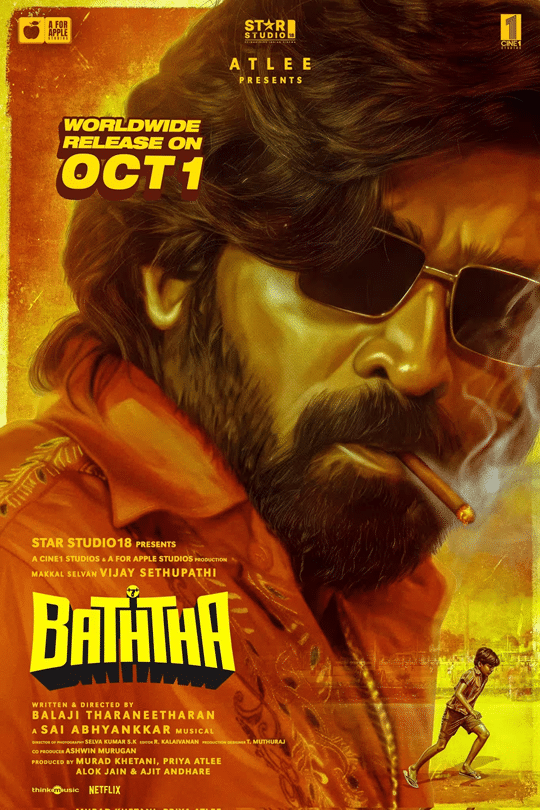
The Tamil film Baththa opens with a Chekhov’s Gun in the form of a wooden door that is being built by a labourer in 1966. Twenty years down the line, this wooden door would act as a third wheel in the uncanny and unlikely dynamic between the two protagonists – Baththa (Vijay Sethupathi), and Sabari (Sai Prithviraj). It is interesting on how the drama subverts both the personalities of the two protagonists – the former being a notorious gangster working on the currency of fear, and the latter being a young school boy who is known to spend this ‘currency’ on some wild tales about the gangster. It is quite ironic on how the little toy of Sabari (that would also go onto double up as a Chekhov’s Gun at some point in the plot) is a playful metaphor of sorts – of two unlikely characters beating up each other at the push of a lever; incidentally signifying the uncanny dynamic of the two protagonists who would oddly be at loggerheads with each other soon, both built on the trait of fear in totally different capacities.
Written by Balaji Tharaneetharan, the characterization in the film Baththa goes a long way in defining the fabric of the narrative. For instance when you are first introduced to the protagonist Baththa – you see him mercilessly beating up a another character, even dismissing the empathetic interference of a female character or her daughter, showing absolutely no remorse whatsoever. It is a very specific trait of masculinity that has defined innumerous films, and the writing uses it as a starting point for the protagonist – almost weaponizing his instilled fear through the lens of the other young protagonist, Sabari. In the same breath, you also see him disrespecting his wife by throwing away a dish prepared by her, only to be countered by his daughter – just as he is about to walk out. In other words, Baththa remains the poster boy of being ‘repulsive’.
The writing is almost quick to define the fearful traits of Sabari, even as you spot him listening to the wild tales of Baththa from his classmates – including a wacky one including the notorious gangster owning a wild cat. It is interesting on how this trait of fear and innocence in Sabari forms a companion piece to his father, whose character is mounted on a similar ideology. At one point in the second hour, his father resists the urge to rat his colleague out, who in turn has beaten him up – simply because doing that would make the perpetrator jobless. Here, being fearful is used as a foreground for being compassionate – but these complex emotions don’t trickle down to the binary lens of a child who still treats it as being ‘fearful’.
The writing employs the Chekhov’s Gun brilliantly – circling back to the wooden door, and the little toy in rather unexpected forms, eventually coinciding the two worlds of the protagonist. You notice the exuberance of youth mixed with an inherent sense of sincerity, even as you notice Sabari heading to his ‘deserted’ school during his vacation, just to fetch his toy confiscated by his teacher. He is sincere enough to close the cupboard door while just handpicking only the toy being the rightful owner. But it is a streak of fear that engulfs him, even as he gets to know that Baththa – in a surprising turn of events is also in the washroom, locking him up just to avoid being ‘killed’ by the verbally abusive gangster; a single event that forms the palpable conflict in the drama.
The writing beautifully christens the narrative with subtle bouts of humour, while wonderfully accounting for several tonal shifts in a rather seamless manner. Be it the idea of Sabari bringing rusk for Baththa, even as the latter runs a checklist on the person responsible for locking him in the toilet, while missing his family in an emotional montage, and calling for help – all in the same breath. There is also a rusk-shop owner, a snake, a piece of letter, a cop – all of who would play a part in the narrative at some point. You notice these tonal shifts that threaten to derail the drama, but the writing remains so seamless with them that I was in awe of the technique.
The tonal shifts in the narrative coincide with the shifting character arc of the protagonist Baththa. At the halfway mark, you notice a shift in its trait that is far from his brash self – embracing his young rescuer (along with his family) with open arms. Yet, the streak of using fear as a currency is still engrained in his DNA – using his daughter’s celebration of puberty as a means to sniff out the ‘rat’ around him. It is ironic on how the humour erupts from the cluelessness of the protagonist, even as the viewers remain two steps away from him, often amused at his antics of buying his young perpetrator new clothes – even as the latter indulges in a little game of cat and mouse, mostly out of fear.
There are a couple of fight sequences sandwiched between tense moments christened with humour – something that leads to a beautifully penned, emotional scene with regards to a revelation (the same revelation is used in the form of a lie early on, almost as its humourous counterpart). It is in that moment that I felt that the drama here is an active companion piece to the beautiful film Meiyazhagan (2024), with both characters forming an uncanny dynamic of love and friendship.
The transformation is complete in a riveting final act that taps into an unexplored side of the protagonist, another tonal shift that defines his exploitation of fear. In reality, all he needed was love and encouragement – two pivotal qualities imparted by Sabari in a moving finale that is enough to make a grown man cry. The subtext remains on how some of the most feared people have a softer side of compassion and empathy, that can be brought out through the simplest acts by people around them. The screenplay is another reminder to be kind, even as I found myself with my heart full – all over again. This, even as a searing commentary on masculinity was deconstructed yet another in the most beautiful manner – in an alternate companion piece to Dorothy (2026).
The dialogues are laced with right balance of humour and emotions that beautifully blend into the narrative. It is a rare film wherein the lies compliment the shifting tones in the narrative, without any line sticking out like a sore thumb. The emotional core of the drama wonderfully resonates with emotional beats of the narrative. The music and BGM capture the shifting tone of the narrative, really well – invariably forming an arc of its own. That said, the music isn’t as memorable as compared to a film like Meiyazhagan (2024), allowing the loudness of a few tracks to overshadow the unravelling drama. But that was just a minor blip in the context of an otherwise supremely effective drama that hits all the right notes.
The cinematography by Selvakumar S. K. relies on a distinct, nostalgic color palette to naturally ground the film in its 1980s North Madras setting. Every shot expertly balances the claustrophobic tension of the bathroom setup with wide, authentic frames of the surrounding neighborhood. The lighting shifts deliberately, casting heavy shadows during tense confrontations while softening into warm, comforting tones for domestic moments. The gritty frames of a gangster drama are balanced by frames of innocence, two pivotal traits nailed by the frames here.
The editing pattern maintains a steady, organic flow that handles abrupt tonal shifts between comedy and drama without feeling jarring. Director Balaji Tharaneetharan brilliantly guides the narrative by turning an absurd premise – a feared 1980s gangster accidentally locked in a school restroom by a child, into a deeply humane comedy-drama. His directorial restraint strips away typical mass-hero tropes, choosing instead to focus on the characters’ inner vulnerabilities and repressed fears. He masterfully balances quirky situational humor with poignant emotional beats, allowing the unusual bond to evolve organically without relying on forced melodrama. Through deliberate pacing and a focused thematic vision, his storytelling beautifully transforms into a moving study of innocence and redemption.
The performances are wonderful to witness by the members of the cast. The likes of Sahasra Shree as Thenu, Ramya Pandian as Jayanthi, and Ajay Ghosh as Pedda have their moments to shine. Arjun Chidambaram as Jyothi can so easily be termed as Baththa in a different demographic age group – and the intensity that he brings to his character is wonderful to watch. Vishnu Govindan as Delhi and Balamurugan as Durai balance the rawness of their personalities with nuggets of humour that make for a couple of hilarious performances.
Hari Krishnan delivers a grounded and earnest performance as Thirunavukarasu, while serving as an essential realistic anchor in the narrative. He handles his character’s dilemmas with understated maturity, bringing a steady presence that enhances the story’s emotional weight and perfectly complements the rest of the ensemble. Santhy Balachandran as Selvi creates a memorable impact within a focused amount of screen time. There is an understated sea of emotions hidden beneath a tough exterior, something that she taps into rather effectively. Lijomol Jose as Kannima brings grounded grace and an authentic emotional depth to the film. She avoids standard dramatic tropes, conveying an enduring warmth and inner strength that provides a necessary pillar for the movie’s family dynamics.
Sai Prithviraj as the young schoolboy Sabari, completely anchors the emotional narrative of the film and acts as a phenomenal foil to the lead star. He captures the innocence, underlying fear, and guilt of his character with incredible maturity, turning what could be a simple mistake into a heart-winning catalyst for the entire story. And he uses his expressive eyes and body language to such great effect here, conveying the emotional plight of his character with bouts of innocence.
Vijay Sethupathi as Baththavachalam aka Baththa delivers an excellent, multi-layered performance that balances stylized criminal bravado with absolute vulnerability. His portrayal transitions seamlessly from comedic frustration to profound self-reflection while trapped, shedding his character’s fierce reputation to reveal an unexpected gentle side. And even in the emotional scenes, he strips away his masculinity while presenting a vulnerable side to his persona that is incredible to witness. He was brilliant as ever here.
Featuring brilliant performances, Baththa is a deconstructed take on masculinity subverted by a heartfelt study on innocence and redemption. Beautifully balancing humour, love and emotion, this excellent watch seamlessly navigates sharp tonal shifts that took me on a heartwarming rollercoaster of emotions, leaving a lasting smile on my face with a tear in my eye. Available on Netflix and Highly Recommended!


