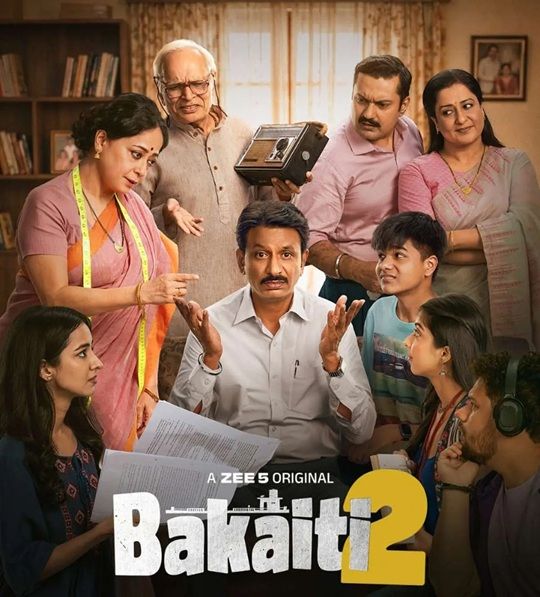

In the new middle-class adventure of the Katariyas in the second season of Bakaiti, the financial woes of the family continue. If this was the world of Mirzapur, the financial troubles would easily translate into illegal weaponry ultimately resulting in murder. But since the setting remains humble, the family patriarch Sanjay (Rajesh Tailang; ironically in his similar moralistic aura as that of Mirzapur) still is struggling to attain cases as a lawyer, invariably prompting him to look towards a shady builder Tyagi (Abhijeet Chavan) in order to illegally clear residents from their rightful land. This, even as Sanjay’s wife Sushma (Sheeba Chadha) is doing reasonably well with her boutique, enough to even support her family and also hire an intern Ishita (Devishi Madaan) for some added work. But this fleeting event also sows seeds of vulnerability and insecurity in the mind of Sanjay – who invariably possesses traits of a sulking patriarch despite being a visible green-flag, much like most men of the society. It probably isn’t entirely Sanjay’s fault, often having being programmed to earn and sacrifice for the family, much like a masked superhero; only for his superpower to be under threat. This, even as Sushma is quick to point out in a fleeting moment on whether she is only looked upon as someone who would serve the family tea (an inference that is repeated at various instances in the narrative).
Written by Abhinav Vaidya, Gunjan Saxena, and Neha Pawar, there is a momentary subplot revolving around a potential leakage in the home of the Katariyas. That itself can be viewed as a metaphor for the multiple conflicts in play – be it the financial ‘leakage’ directed towards the eldest daughter Naina (Tanya Sharma) who has shifted to Mumbai to complete her education; or the ‘leakage’ of confusion centered around her tryst with her bestie Kevin (Rtwik Nambiar); or the societal ‘leakage’ of discrimination and hierarchy faced by her in trying to fit into the English-speaking clan of her college; or the relationship ‘leakage’ between Sanjay and his brother Ajay (Parvinder Jit Singh) centered around the redevelopment of their house, the seeds of distrust which were sown in the first season itself; or the ‘leakage’ of morality of the youngest son Bharat (Aaditya Shukla) who desperately wishes to earn a place in a professional cricket team even if it would mean to bribe his coach; or the ‘leakage’ of memory on the part of the eldest family member Nanaji (Ramesh Rai) who is unknowingly suffering from dementia.
Clearly, the writing wishes to explore the dynamics between the characters – combining the collective consciousness of a middle-class family, and the issues that they face. In fact, some of the everyday conflicts reminded me of the TVF show Gullak (2019), wherein simple problems give way to simpler solutions. In a parallel world, the Katariyas would have formulated the fabric of a Sooraj Barjatiya film – if the financial woes wouldn’t have plagued the family.
The title of the show holds an endearing relevance, often presenting a deeper metaphor for the direct translation of ‘arguments’. And to understand this deeper, the writing also introduces the conflict of the setting itself. The confinement of the space plays an important role in the cross-firing arguments between the characters. It is similar to the age old idiom around vessels and containers in the kitchen creating a screetching noise when placed together in confinement. So in a scene when Ajay gets to know that his own house is flooded due to incessant rains, he in invariably trapped in confinement with the one person that he cannot handle. Familiarity breeds contempt, or so is the case with most joint families.
The other subtext of the title is the art of staying together, and the art of togetherness. Hence in multiple instances, you witness the family sticking together through thick and thin – despite their differences. Be it in a fleeting moment wherein Naina decides to gently confront her father, deftly asking him to share his ‘specific’ vulnerability, or a scene between Naina and Bharat involving a tender moment that cuts through the fiesty fights that they share over petty things, or even Ajay volunteering to share the cost of the house maintenance or the hospital bills after a sudden medical emergency, or a quiet moment shared between Sushma and Sanjay about how the financial burdens of the family can be divided between the two.
My prime issue with the writing remained in its ability to be simple. And simplicity here isn’t equated to simplistic resolutions. Instead, it frequently stumbles into a frustratingly low-stakes formula, where deeply rooted conflicts are abruptly wrapped up in breezy, feel-good montages. Rather than letting the narrative get beautifully layered or complex, the writing opts for linear steps to solve heavy-duty emotional problems. While this breezy pacing keeps the tone light, it robbed me of genuine catharsis – leaving major character arcs feeling short-changed while several narrative threads are simply abandoned, dangling open without a proper conclusion. A little more depth in the resolutions (like in the first season) wouldn’t have hurt, summing up the screenplay here that is warm, comforting but nothing beyond that.
The dialogues are conversational but presented at a high pitch, almost in the form of bickering between characters, that may divide the viewers initially. In fact once you come to terms with this fact, you will be able to enjoy the drama a little more. But this caution is just to manage your expectations with this one. The BGM goes well with the light-hearted ‘Middle Class’ theme of the narrative, while doing its bit to keep you invested in the drama, and the journey of the characters. The same applies to the cinematography, with frames that allow you to stay connected with its characters. I also liked how the frames allow the setting of the Katariya household to play a character of its own, just like the clayed pot in Gullak – being an uncharacteristic voyeur to the arguments on display.
The editing pattern stutters in a few moments, keeping the emotional core of the drama intact but missing out on the conflict that isn’t always brewed. In an instance, you see the character of Tyagi entering the Katariya household with bouts of anger, only for the next episode to cut short this conflict.
Director Samar Iqbal keeps things simple. He doesn’t employ too many flamboyant techniques, and rightly so, as it contributes towards the simplicity of the characters, their conflicts and their journeys. There is a hint of sweetness that comes as an aftertaste, keeping the emotional core of the characters in check. My only issue remained that of the simplistic resolutions in play that cut short the overall impact of the drama. But the direction remains decent here.
The performances are pretty good by the members of the cast. Devishi Madaan as Ishita manages to impress here, while being sincere and earnest with her act. Abhijeet Chavan as Tyagi is menacing and intimidating although the writing doesn’t fully allow his character to blossom. Ramesh Rai as Nanaji has a playful presence given his fascination for television, that rightly captures the loneliness of an elderly stateman in a family who remains largely disconnected to the main conflict of the family. Also, his tryst with dementia marks a gut-wrenching reality of life laced with unpredictablity, something that the writing ably addresses.
Shashwat Chaturvedi as Aman has his moments to shine. Poonam Jangra as Alka and Parvinder Jit Singh as Ajay are impressive, while often being indirectly at the center of the conflict. Their arguments are boisterous but their empathy and care is passive, the latter that pops out during a family crisis. And all these shades are wonderfully accounted by the talented duo. Rtwik Nambiar as Kevin is quietly charming and delivers a restrained performance, showcasing moments of calmness amidst the chaos.
Aaditya Shukla as Bharat has a raw flair for comedy wherein even his high-pitched dialogue delivery results in a bunch of laughs. He definitely manages to get into the skin of his character while touching upon the various traits of carelessness and empathy with respect to his character. Tanya Sharma as Naina is a dynamite performer, commanding your attention in every scene that she appears. Not only does she boast of a towering screen presence, but she rings in the right degree of emotions that almost always land. She remains committed to her character by using her body language and expressions perfectly. And that makes her character wonderful to witness with the right amounts of emotions inflicted in between. Also, I liked how maturity was seamlessly written into her character from the last season.
Sheeba Chadha as Sushma is a character often sandwiched in the conflict. There is an inherent commentary of patriarchy right there, given how she often doesn’t have a say in the most critical issues of her family, almost choosing to stay silent. But like all mothers, she is the balancing cog of the family – often having to choose on whom to side with, while allowing flaring tempers to subside. Her frustration at times is directed towards her children, but you can make out the empathy in her anger too, that stems out of the utmost care for her family. And Sheeba nails her performance beautifully here.
Rajesh Tailang as Sanjay is the silent warrior of the Katariyas. Much like Kannan from Madras Matinee (2025), the character goes about his duties without any aspirations, but with a hope of a better tomorrow for his family. You see the conflicts with his brother, that fans his tempers at most instances in the drama. This, along with his vulnerability that invariably transforms into an unsaid take on patriarchy. Yet, you feel for him when the expenses of his family overpower the money that he has saved for his daughter’s education. You feel his helplessness while he silently buries his guilt and frustration within him. And Rajesh beautifully encapsulates the chronicles of a middle-class father, being a superhero in his own right but without a caper, caring for his family but unable to express it. And the emotions beautifully come through in a wonderful little act that stems out of resilience.
Building upon its established foundation with consistently solid performances, the second season of Bakaiti continues its heartwarming yet flawed celebration of middle-class family dynamics, delivering another low-stakes but comforting layer of slice-of-life drama. While the series successfully captures the relatable warmth and evolving togetherness of its central characters, it occasionally stumbles under the weight of overly simplistic resolutions that wrap up complex conflicts a bit too conveniently. Nevertheless, these narrative missteps rarely diminish the show’s ongoing charm, allowing its genuine heart and strong character chemistry to shine through and making this outing a decent watch despite its imperfections. Available on Zee5.