

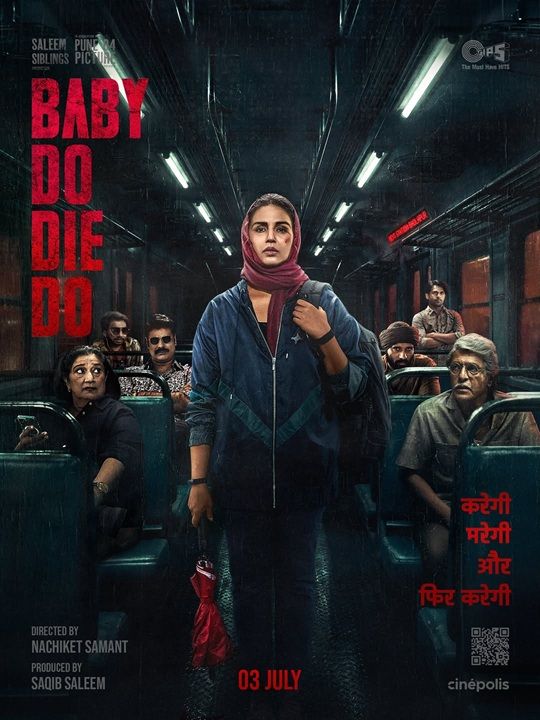
There is something about the city of Mumbai that coincides as a pivotal character in the Hindi film Baby Do Die Do, transitioning from its black grainey imageries in a flashback to the neon-lit advertising hoarding lighting up the surroundings, which are otherwise dripping in rain and darkness. There is a mood of familiarity in the drama at the start that touts itself as a female-assassin origin story (the 2nd one this weekend after Alpha) – two twins entering an abandoned five-star hotel, only to witness a brutal murder, and just one surviving by the end of the events of the night. So when you are reintroduced to the protagonist Baby (Huma Qureshi) years later, you see her callously murdering a man in a local train with her inventive umbrella-turned-gun. Interestingly, nothing much has changed around her – the city continues to remain dark and gory, often owned by the real-estate sharks and businessmen – with a nod to Kennedy (2026), except that it is now the protagonist that has blended with the surroundings that have taught her to survive.
Written by Jasmeet K Reen, Nachiket Samant, and Parveen Shaikh, the title Baby Do Die Do offers a clever spin on the name of the protagonist – Baby Karmarkar that pretty much goes Kar-Mar-Kar. What this does is set the tone of the drama with the infusion of dark humour that essentially forms the crux of the drama, while also focusing on the personality of the protagonist. She is mute and deaf, a trait that has not only helped her survive in the big city but also has allowed her to blend in the darkness of the city. And hence, while she is taken care of by a fatherly-figure PM Jain (a refreshing Chunky Panday) – someone who doubles up as her handler by getting her ‘hit’ assignments, there is also a love-interest featuring a non-toxic green-flag of a guy Siddhu (Rachit Singh), who triggers a mini flashback emulating the silent-era.
The mix of crime is evident in the city whose social fabric is decaying as much as its shifting superficial landscapes. At the helm of things remains a real-estate shark Zafar (Sikandar Kher) who remains the kingpin of his profession – alluring and threatening builders, while passing on the assassination job to Baby through her Papa. It remains a specific reference in the narrative given how it epitomizes the stillness of the city with respect to the past and present of the protagonist – she (along with her sister) is witness to murder in their childhood, while being a part of the murderous trail in the present. Murder remains constant, just the evolution of it has changed.
The fabric of the drama is defined by its quirky characters that assert the dark humour in the narrative – a young neighbour, a fellow hitman who ‘misses’ his mark, a corrupt cop, a ‘gay’ businessman, a clerk at the high court (referenced as B&W due to his vitiligo) to name a few. And interestingly, the dark humour is infused through the situations and settings of the characters – a gay club named ‘Alpha-Q’ that is a hilarious take on its own title, a murder of a businessman being followed by a picture of his younger days with a meta-nod to Tum Bin (2002), an accidental discovery of the umbrella-gun by a character that would make PETA very angry (hint : winner winner ‘pigeon’ dinner). The events are quirky and enticing – both of which co-exist almost perfectly.
The drama minutely suffers from the familiarity of the proceedings, given how the ‘mystery’ is revealed right in the first act, and with the twists that can be seen from a distance. But in hindsight, it also epitomizes the predictability of the city – wherein nothing changes besides the towering buildings centered around the wealthy businessmen and real-estate sharks. The non-serious commentary on classism is deftly evident with a specific plot-point involving a humble ghetto being set ablaze, presumably against the backdrop of the skyscrapers.
I must admit that the end remains a bit of a mess, with moments of convenience engulfing the narrative. But even in that space, the writing scores over the other female-assassin release of the week Alpha, simply because it doesn’t lose focus on the internal journey of the protagonist (despite the quirks around her). There isn’t an external character who would have links to a top gangster, while the nationalism of the protagonist would enter the chat. The journey is always internal, always about love, always about revenge, and always about who has stayed back. And that makes the screenplay work here, expanding itself beyond the familiarity of the genre.
The dialogues are grounded to the decaying side of the city, while finding bouts of humour through its situations. The music and the BGM work in tandem to create a specific phase of eccentricity in a world of messy trance, that itself felt like an alternate character in the mix.
The cinematography by Tojo Xavier is to (do) die (do) for. Be it the grainy monochromes that mark the start of the decay, or the neon-lit hoarding against a rainy backdrop that account for the superficial upgrade in the infrastructure, whilst keeping the decay intact – the frames almost create an ambience of a neo-noir thriller. Amidst these, there are moments of quirks employed – a silent love-story playing out while providing a homage to the silent era, or a murder playing out in reverse as viewed through the CCTV camera. Or even a split screen involving a character employing sign-language that is mapped to the words she infers. The frames are exceptional while allowing the setting to play a pivotal character in the mix.
The editing pattern is pretty crisp, something that keeps the run-time of the drama in check. This, while maintaining a cohesive thread that keeps you abreast with the emotional core of the protagonist. Director Nachiket Samant has a significant improvement from his previous venture Single Salma (2025), creating a decaying world that almost remains a nod to Sin City (2005). And even through the quirks employed, he doesn’t lose sight of the personal conflict of the protagonist, something that continually keeps the drama grounded in reality. He shows purpose through his craft, allowing the setting to essay a parallel character that is as broken and as seething as the protagonist, even though I felt that the direction could have been a little tighter through the ‘kills’ – something that could have been a little more exciting. But nevertheless, the direction still finds moments that are rare, and for that alone, the film deserves to be watched.
The performances are wonderful by the members of the cast. Himanshu Malik as Micky and Vidya Malavade as Manju form an interesting combination of quirk and ice, and both of them manage to impress. Kailash Waghmare as B&W More offers some ticklish quirks to his persona and performance, and he definitely has his moments to shine. Arun Kushwah, Ashish Warang (in probably his final outing) and Rupesh Bane are wonderful performers, and each of them offer a different dimension to the narrative – in a job well done. Seema Pahwa as DSP Khan is well restrained with a streak of quirk that ably drives her character, and she is a treat to witness despite a limited screentime. Marudhar Shekhawat as Manu is sincere and earnest with his performance, although the brief stint of guilt is short-lived – something that would go down as a writing flaw.
Rachit Singh as Siddhu (you may remember him from a brief role in Thama (2025)) has a solid screen presence, and he adds some wonderful palpable emotions to the mix, while staying true to the dark and quirky world that he is a part of. Chunky Panday as PM Jain is refreshingly good in a character that requires him to be grounded and understated. This is far from his ‘Mamma-Mia’ acts that have defined his recent identity. His performance remains layered and vulnerable, even as he puts forth a solid performance.
At this point, I would watch anything that features Sikandar Kher. He is such a phenomenal talent who uses his expressions and body language to such good effect, without overtrying. And that is exactly what you get with his performance as Zafar, a character that is intimidating and brutal, but also quirky. He is brilliant to witness here in a job done to perfection.
Huma Qureshi as Baby Karmarkar is in top form here. She is often spotted with a deliberate poker face, that adds chills to her persona. This, even as she effectively uses her expressions to convey the emotional vulnerability of her character that is haunted by her past. The scars have toughened her, while allowing her to blend in with the crime-induced setting of the city. In that sense, this remained a layered act that is wonderful to witness, and in perfect sync with the undertones of the drama. And on a side note, she excels in a couple of combat sequences at the end too.
While Baby Do Die Do follows a largely predictable narrative path, its visual language elevates the familiar material. The film shines as a remarkably stylish thriller, driven by sleek visual direction and a tense, atmospheric score. Anchored by strong, compelling performances from the lead cast, the movie successfully maintains its momentum. It ultimately overcomes its formulaic beats to deliver a thoroughly engaging and solid watch for genre fans. Available in a theatre near you.


