

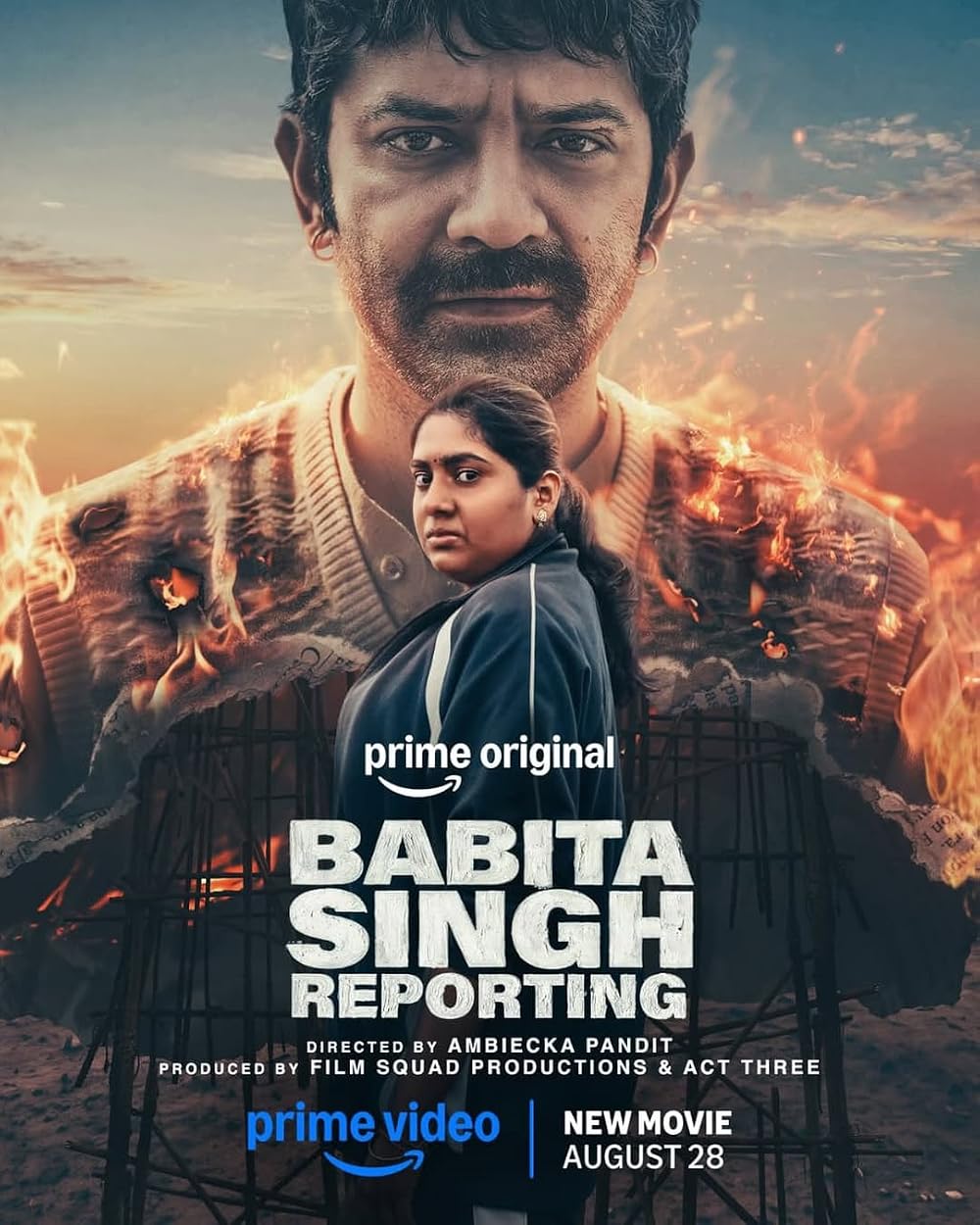
In an early scene in the new Hindi film Babita Singh Reporting, you are introduced to the character of Babita (Nimisha Sajayan) taking a video of her superior on a bike – that would symbolize his machismo in a potentially viral reel. That cold open tells you a tale or two about the prevalence of masculinity and patriarchy in the immediate vicinity in the life of the protagonist, often playing a second fiddle while being viewed upon as a secondary citizen in her own work place. Babita is a cop, but her work station is governed by her sexist superior Sethi (Rajesh Kumar) who often refers to her as ‘Baby’ – a supposedly harmless inference that reeks of control and sexism, in what is viewed as a male-dominated ‘job’. You witness her meek persona while gently pushing for her leave application in return for the video that she has taken, only to be handed over an option of ‘suspension’ to fulfill her demand for a ‘mistake’ that was actually committed by Sethi. It is a patriarchal world, and thr protagonist is merely looked upon as a little ‘Baby’ in it!
Written by Amita Vyas (Executive Producer is Sudip Sharma of Kohrra fame), Babita Singh Reporting almost follows the footsteps of Kohrra (2026), even as the protagonist finds herself increasingly obsessed with the murder investigation of her friend Bansi (Barun Sobti). And I use the word footsteps, because the ‘mystery’ remains just a medium of gaining access into the moody world that is filled with patriarchal tropes that define the fabric of the drama.
In that regard, the protagonist in Babita Singh Reporting can easily be a distant cousin of Dhanwant Kaur (Mona Singh) from the second season of Kohrra – ironically, both being female cops caught in a male dominated world. This remains true even for the personal life of the protagonist that is marred by casual sexism, something that remains a nod to the other Nimisha Sajayan starrer The Great Indian Kitchen (2021). It is almost like a horror story that unfolds as a drama, even when you are introduced to her husband Sharad (Anshumaan Pushkar), and his family.
The micro instances of sexism define this palpable horror story, something that begins at home for the protagonist. In a scene, she is pressurized to fulfill her role as a daughter-in-law and as a wife, even as her husband casually taunts her for her job that doesn’t offer her any leaves, citing how he is enough to run the show (hinting at wanting her to quit her job). In another scene, you see him manipulating her into taking a trip with him to his hometown, all in order to cater to the basic needs of his pregnant sister.and his mother. It is ironic on how the family fat-shames her about her thyroid condition, even as Sharad is quick to remind her on how he is still together despite her weight issues, and her inability to bear them a child.
In that sense, Sharad remains an infuriating character, a red-flag designed as a green-flag much like Arun in the show Khauf (2025). The moment he witnesses his wife retaliating, he sweet talks her into a moment of compassion to calm her down, even while continuing to casually taunt her every now and then. In a searing scene, you see the torments of the family headed by Sharad – giving a helping hand to his mother to get off a boat, while leaving his wife behind to fend for herself in order to make it out. Or an immediate next scene involving the family at a local icecream shop, only to hand out a ‘sugar-free’ kulfi to the protagonist, hinting at her excessive weight despite her thyroid condition. Or in another instance, wherein the protagonist is at the receiving end of a gift that is disliked by her sister-in-law. Or an instance involving the protagonist having to serve gift boxes to guests, even with an injured foot. In a brief moment of criticism, I did feel that her personal life was slightly superseding the investigation in a 10 minute phase in the second act, but that is just me nit-picking here!
It is interesting on how the protagonist forms a parallel with her friend Bansi, the latter who has a presence throughout the narrative. For instance, it is Bansi who is indicated to be a noble soul trapped in a pile of issues of his own, something that the protagonist witnesses through a series of suspects. This includes his wife with burnt hands, his elder brother who potentially dominated him, his ex-flame whom he chose to help with a bag of cash unknown to people around him including her abusive cop husband, who ensures that her journey is also reflective of the journey of the protagonist. Bansi’s journey is a cinematic to Babita, often separated by gender – a key trait that contributed in people praising him even after his death.
It is also interesting on how guilt plays a part in fuelling Babita’s investigation around the death of her friend – simply stemming from how he was the only one who supported her in school, while also wishing to meet her after she returns to his hometown – a meeting that never transpires due to his death. And invariably, his investigation also fuels her coming of age story that forms a vital symbolism with the cutout of Ravana during the festival of Dussehra, as shown in the drama. The subtext remained on how the inner self of the protagonist could be discovered only by destroying the effigy of negativity, while having to resist its heat stemming from people around her (a subtext that could have been extended to her deceased friend too; one denoting strength stemming from her marginalized gender, and the other weakness, stemming from a place of privilege). The climax is quite symbolic in that sense too (although many may get the impression of it being anticlimactic), while completing a coming of age arc for the protagonist in the most thoughtful manner possible.
The dialogues are grounded in reality, often offering a searing commentary on patriarchy and masculinity through its subtext. The exchanges are poignant, without sensationalizing the narrative. The music and the BGM feel earthy, often aiding the gentle moments of poignancy and exposition with a hint of finesse, tactfully allowing the unfolding drama to take centerstage and elevating the micro moments deftly.
The cinematography comprises of frames that contribute to the moody ambience of the drama, something that oscillates between a Shakespearean tragedy and a coming of age story. The frames are focused on the unfolding drama through the testing eyes of the protagonist – a trait that invariably makes this a searing character study laced with a powerful social commentary, even as I found myself emotionally attached to the journey of the protagonist.
The editing pattern is non-hurried, allowing every moment to realise its full potential – while allowing the transfer of emotions from one scene to another despite two tracks being played out in parallel. And the connecting thread remains the person journey of the protagonist, that invariably piques your interest, even as the editing pattern is successful in holding the narrative together.
Director Ambiecka Pandit is successful in creating a moody ambience of a tragedy subverted as a coming of age drama, something that unfolds as a searing character study. She is tactful and sensitive in incorporating a resounding and relevant social commentary that forms a character of its own in the narrative. I liked how the filmmaker balanced the twin narratives in the drama – with one being a medium to enter the world of the other. There was control to her craft that allowed the drama to simmer on slow heat, while eventually summing up the arc wonderfully well. And this meant that the direction was pretty impressive through and through.
The performances are wonderful to witness by the members of the cast, and a huge shout-out to the casting director Nikita Grover for handpicking some real talent in this ensemble. It is interesting on how every character remains an extension of the social commentary that is true to the character of the protagonist. For instance, Muskan Arora as Archana and her husband Rajat Dahiya as Bharadwaj form an uncanny parallel to Babita and Sharad, being the couple from a different timeline. You notice the subdued nature of Archana, and the dominating and abusive presence of Bharadwaj (in a role reversal of sorts, being a cop just like Babita), that are ably performed by its two brilliant performers.
In the same breath, Priyanka Setia as Rupa, Priya Yadav as Guddi, and Sunita Rajwar as Babita’s mother-in-law remain three distinct characters consumed by patriarchy, to the extent that each of them are shown to be supporters of it. While Guddi and her mother are known to taunt their way into the life of Babita, Rupa is fighting a battle of her own – being dominant towards her husband Bansi, which formed an unsaid variant of patriarchy and the kind of dominance that it brings with it. And all three of them are wonderful to witness in stellar acts, through and through. Likewise, Gaurav Kalushte as a fleeting character remains a victim of the problematic society too – using drugs as a means to earn a quick buck, as opposed to the society taking responsibility for a change.
The parallels extend to Nitin NS Goel as Mangal, and Rajesh Kumar as Sethi – both contributors to the patriarchal tropes of the society in different ways. It is ironic though on how each of these characters use patriarchy as the main form of privilege – both coming across as dominating and problematic in different ways. And both of them are wonderful to witness through their set of mannerisms and expressions, that ably separate the two forms of patriarchy.
In that sense, Geetika Vidya Ohlyan as Karamjeet forms as extension of Babita but on another timeline, having endured the tropes of patriarchy, and eventually traversed her way to the top. This remained a rather dignified act by the prolific performer, often doubling up as Babita’s confidante and guiding force.
Anshumaan Pushkar as Sharad isn’t a character that would instantly repel you. You see him contributing to softer moments of compassion, that often matches the problematic, patriarchal traits of his persona. He is the kind of a red-flag that can easily be passed off as a green-flag, being callous with his taunts that reek of sexism but approaching them with an understated tone. His character epitomizes the kind of men that most women are dealing with – doing just enough to stay in the relationship although that is really the bare minimum requirement of being a better half, whilst allowing his masculinity and patriarchy to be a point of contention for the women – a trait that is oblivious to himself but evidently visible to his wife. He was stellar in maintaining this balance, doing an excellent job here!
Lastly, it is Barun Sobti as Bansi and Nimisha Sajayan as Babita that form a searing parallel of being essentially the same person marred by patriarchy but separated by gender. The former immediately makes an impression in that one scene at a start, something that exuded of nobility and humanity – instantly making Bansi a sincere figure backed by an earnest performance.
But it is Nimisha Sajayan who puts forth a performance for the ages. As Babita, you witness her subdued nature at the start, something that remains a crucial starting point of her arc in what felt like her coming of age story. She uses her expressions to represent guilt in the most palatable way possible – epitomizing her internal turmoil, while putting forth a resilient demeanor. Her character is as much driven with curiosity, as much as it is with guilt. The former remains a part of her subconcious mind, with the want to prove her identity of being a cop outside her tag of a ‘Baby’. And the later stems out of regret of not getting to meet that one person who supported her in her childhood. In that sense, this remained a rather nuanced act that was christened with simmering emotions, all of which land wonderfully well in this incredible woven performance of the highest order! She is the finest actor doing the rounds at the moment!
Babita Singh Reporting is a masterful, character-driven slow-burn film that brilliantly subverts traditional investigative tropes to deliver a searing commentary on societal masculinity and patriarchy. At its core, the movie unfolds as a profound coming-of-age journey, allowing emotional stakes to simmer through subtly powerful performances. By utilizing the investigative process to dissect societal barriers rather than chase fast-paced thrills, this thought-provoking film scores heavily on thematic depth. Available on Amazon Prime Video, and Highly Recommended.


