

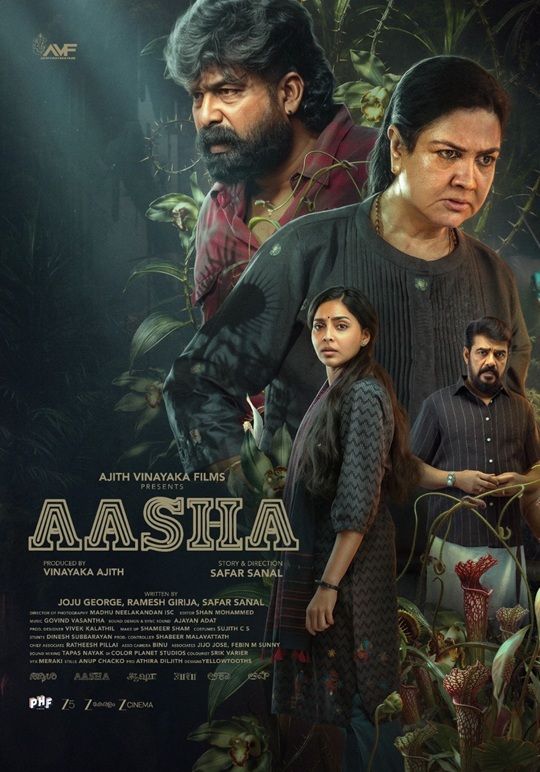
There is a definite Shakespearean undertone prevalent in the new Malayalam film Aasha, except that this undertone remains subdued and personalized to the persona of the protagonist. Early on, you do get a glimpse of her fiercely independent but impulsive psyche – even during her interactions with people around her. In a couple of early scenes, you notice her friction partly erupt with the worker class stationed to renovate her home. Likewise in a bunch of early scenes with her daughter Anagha (Aishwarya Lekshmi), you notice her instant disapproval about the latter’s relationship with a guy from her IT company – instead, pushing the case of a marriage proposal through her background and influence. It remains a very specific indication of the protagonist using ‘control’ as a means of escapism – owing to her past trauma related to suppression. The suppression in itself has stemmed from a fractured relationship with her husband (who has passed away), further symbolic of the fractured home that she resides in. Ironically, her unfinished home is also symbolic of her fractured psyche, something that would later transform into a symbolic form of ‘control’ following an incident.
Written by Joju George, Ramesh Girija, and Safar Sanal, Aasha can be termed as an alternate companion piece to films like Drishyam (2013) or Ayyappanum Koshiyum (2020), particularly with the central incident that unfolds at the start. In a scene, you see the protagonist and her daughter being involved in a minor road accident, only to trigger a game of perceptions for the viewers. The accused remains a hefty blue collar worker Jeemon (Joju George) who invariably reeks of foul-play from his mannerisms and demeanor – both of which are integrated to create an air of doubt in the minds of the viewers. This initial impression remains pivotal for a second incident that transpires, this time involving the protagonist’s daughter Anagha, who after a quarrel with her mother leaves her home only to be found hospitalized under mysterious circumstances, with all fingers again pointing towards Jeemon.
The setting is laced with intrigue, even with a familiar angle of vengeance that laces the narrative with regards to the protagonist. It is interesting on how her controlling habit has transformed into an impulsive trait that makes her orchestrate her bout of revenge against both men (Jeemon and his helper Asif) that may have unsaid parallels to her past; of overpowering her own husband who had inflicted several bouts of trauma. Her confirmation bias is something that ties up with the initial quote of the film – ‘Killing a Cockroach makes you a good person, but killing a butterfly makes you a bad person’.
There is an undertone of toxicity that eventually leads to an array of blindness for the protagonist, even as her revengeful maternal traits causes a death in her premise (following a tremendous interval block), while severely injuring the other. But this is also where the writing drops a truth bomb with respect to the perceptions of the characters, flipping the narrative with that one source of truth that spirals the psyche of the protagonist into a bout of guilt.
One missing link in the second hour remained the predominance of an unfolding investigation, something that is just hinted at towards the final act. As a result, the cat and mouse game between the characters remains a little unexplored, something that slightly lowered the intended impact of the drama. Having said that, the repetitiveness of the proceedings is subverted by the dynamics shared between the protagonist and Jeemon, that constructs an intriguing fabric of thr narrative.
There is a hint of the film Obsession mixed with a trait of Stockholm Syndrome, even while witnessing the evolved bond between the protagonist and Jeemon, the latter now being tied up inside her house like a captive. The cautious demeanor of a crime being committed subverted by a sense of guilt is what defines the persona of the protagonist, even while trying to partially make amends by taking care of him in a captive state. But it is here that the predictability of the plot slightly lowers the impact of the narrative here – a phenomena owing to plenty of thrillers being witnessed on celluloid. The Drishyam-coded incident with regards to a dead body in the vicinity just could not be ignored.
I liked how the writing added a dual personality to the protagonist, who remains a captive in her own rights. Being sandwiched between the roles of being a victim of the circumstances and the perpetrator of the orchestrated situation, you also get another variant of the metaphor with regards to the unfinished house of the protagonist – trapped in a psychological state that is hard to amend. Hence, the finale also stems from this phenomena – a confused and undecided state of panic that eventually has its say with regards to the fate of one of the characters. Yes, one could argue that the finale itself is abrupt and slightly leaning on it being manipulative – but it is reflective of the unsteady psyche of the protagonist that offers no solutions. That said, I wished there was a little hint at the end on how the protagonist’s life has changed as a part of its prologue. But overall, the screenplay is pretty engaging while boasting of several moments to shine.
The dialogues remain understated to the fabric of the narrative whilst gently elevating the persona of the characters through their exchanges. For instance in a little scene, you sympathies for a character like Jeemon rise when he states on how he is trying his best to make amends with his family who have left him – an inverted arc of sorts to the protagonist’s husband who had only given her grief. This, even as the protagonist is imparting measured grief to a character who is largely innocent, all due to her confirmation bias. The music and BGM do their bit in creating an aura of intrigue to the proceedings, while subtly elevating some pivotal moments in the narrative.
The cinematography comprises of frames that allows the drama to unfold like an edgy psychological thriller. Be it through the brownish tinge used as filters to the frames, or the claustrophobic setting of the dingy room that stations a character – all of these instances are successful in creating an ambience around the setting for a maximum psychological impact. Additionally, the tight frames are also enough to give us a sneak peek into the psyche of the protagonist and the characters around her, thereby creating a conflicting outlook for the viewers too – whether to root for her or hold her accountable. And the single-take drone shot at the end was the icing on the cake!
The editing pattern is pretty crisp, while also doing well to hold the narrative together. There are only slight moments of lag in the second hour that would give an impression of the drama being repetitive – but largely the editing is sharp. Director Safar Sanal masterfully escalates a grounded domestic crisis, triggered by a road accident into a high-stakes arena of psychological friction, prioritizing the realistic behavioral traits of a worrisome but toxic mother. He allows tension to build even in scenes that seem fairly predictable and familiar, thereby showcasing his craft of creating a tense atmosphere pretty well. Barring a few pacing issues in the second hour and an underpar finale with regards to the execution, the direction remains pretty solid.
The performances are wonderful by the members of the cast. The likes of Amrutha Krishnakumar as Dr Dhanya, Prasanth Alexander as Sabu, Lakshmi Menon as Anitha, and Vijayaraghavan as Santhosh have their moments to shine. Aishwarya Lekshmi shines as Anakha, bringing a grounded authenticity to her role as the daughter caught in a fragile domestic dynamic. She captures the emotional exhaustion and friction of living with a controlling mother with remarkable grace.
Joju George delivers a commanding performance as Jeemon, perfectly matching the tension demanded by the screenplay. He transitions effortlessly from a terrifyingly volatile, menacing individual driven by burning rage into a vulnerable victim who evokes genuine sympathy. His raw physical energy and expressive eyes provide a powerful counterweight to the narrative, ensuring that his presence remains gripping throughout the narrative.
Urvashi as Aasha delivers a masterclass in acting by anchoring her character with a deeply layered and brilliant performance. She masterfully adopts a minimalist approach, relying on subtle facial expressions and a controlled body language to project profound maternal anxiety and psychological strain. Her quiet intensity and flickering micro-expressions effectively capture the complex, unpredictable nature of a hyper-independent widowed mother.
Despite an abrupt finale, Aasha is a gripping psychological drama featuring brilliant performances, seamlessly blending a minimalist exploration of fractured family dynamics with the high-stakes tension of a home-invasion thriller. It remains a searing character study delving deep into the conflicted psyche of its protagonist. While a somewhat predictable second hour leaves a few blemishes with bouts of repetitiveness, the film’s intense dramatic friction ultimately makes it an intriguing and worthwhile watch. Available on Zee5.


