

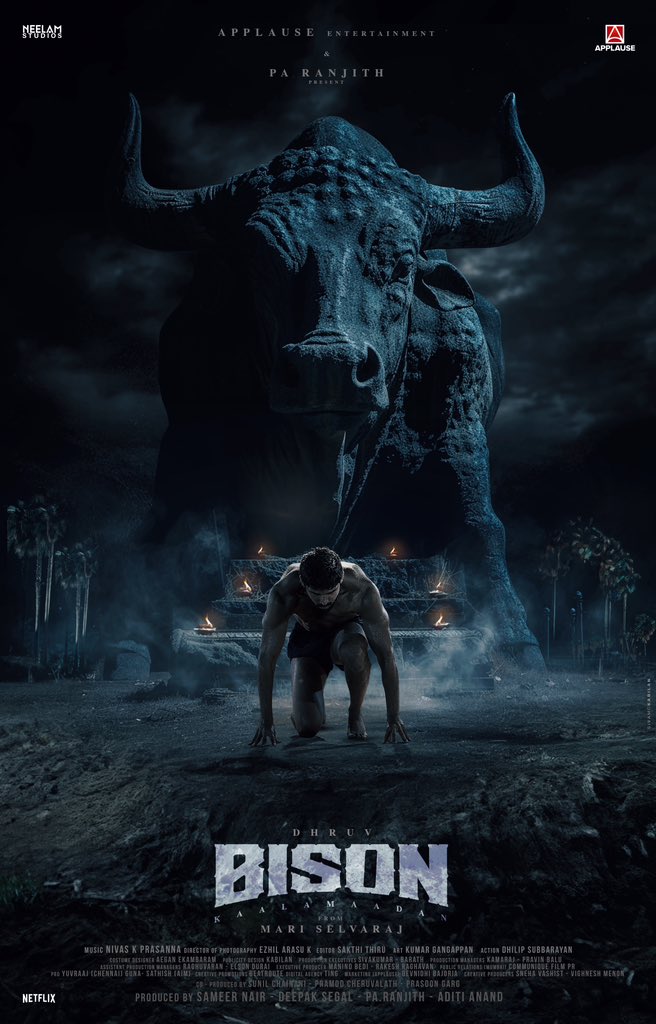
At the start of the Tamil film Bison Kaalamaadan, you see a host of people sitting in front of a black and white TV screen, in anticipation of their favourite Kabaddi player finally getting a game versus Pakistan at the 1994 Asian Games. It is a fleeting metaphor of a person being caged in a box (read: TV) with his life being a monochrome, even as the head coach of India is resisting the decision to make that Kabaddi player play. It is immediately established that the life of Kabaddi player Kittan (Dhruv Vikram) hasn’t been kind – even as he has had to struggle from a small village to where he is now. But given that this is a Mari Selvaraj film, the drama here isn’t your typical underdog story that would accompany the standard tropes of an underdog story. In fact watching this film is like flipping the pages of a book on the life of Kittan, except that the chapters are shuffled and the narrative is non-linear. This isn’t a coincidence either given the complex issues that Kittan has had to face with respect to the caste discrimination and violent feuds of his village, something that elevates the drama beyond a regular drama on sports.
Written by Mari Selvaraj, Bison Kaalamaadan has the unique ability to blend different themes with intercutting scenes. In an early scene, you spot Kittan being reprimanded in school while being asked to run around the school compound. And even as he begins his run and continues and continues and continues, you spot an intercutting scene of him running behind a car from his childhood. That scene tells you a thing or two about his family dynamics, his oppressed caste inherent in his family (read: he is shirtless), and the symbolism of running – something that he has been doing from his childhood with respect to the problems at hand. It is almost certain that running for Kittan is a distraction, often resorting to it in order to separate his current reality from his goals – even while aspiring to be a Kabaddi player against the will of his father Velusamy (Pasupathy).
It is interesting how a fleeting scene defines the life of Kittan in the wake of his father’s decision of not wanting his son to pursue Kabaddi. It is an anti-thesis of sorts given that the scene unfolds at a local hotel wherein Kittan’s ever supportive teacher takes him out for a meal. Soon after a series of events, you see Kittan hiding behind a wall even as bloodbath ensues in the hotel – an important scene given that it defines the helpless nature of Kittan in the midst of violent feuds in the village. In another world, Kittan would be on the other side – even being the one yielding a knife or worse, the one being stabbed. The scene also defines on how there are other Kittans like him who aren’t as lucky.
The characterization in the drama also remains an important cog in the screenplay, particularly given how grey the characters are. The approach isn’t binary too – even as you are introduced to two warring lords belonging to separate castes – Pandiyaraja (Ameer) and Kandasamy (Lal). In a scene, you witness one of them stating on how no one really remembers on how the feud actually started, but as things stand – one is witness to a bloodbath amidst multiple occasions of wanting to kill each other in the chaos. And the war isn’t restricted to either of these individuals only – it also extends to people who support them. So on one occasion the ones supporting would hug them, and on the other hand, the ones opposing would hunt them. It isn’t easy to pick sides, something that Kittan experiences – often being sandwiched between the two even while just wanting to participate in the game of Kabaddi.
There is a dilemma for Kittan even with respect to his own identity. In a moving scene, you see Kittan expressing his angst on how he had form enemies even before being born, referring to the caste that he belongs to. In another, you see him wanting to retaliate amidst locals who happened to kill their bison as a form of retaliation. Bison for Kittan is sacred and a Godly figure that he refers to as Kaalamaadan, so when his God is killed, there is retaliation only for Kittan’s father to stop him. The dilemma then remains on whether to be aggressive or be passive, particularly in a land where his God is dead!
The same sentiment is played out in two folds – one during his Kabaddi matches wherein he is often looked down upon, and the other being his tryst with love with a local girl called Raani (Anupama Parmeswaran), someone who is from an upper caste. The two struggles remain in parallel, even as Kittan remains focused on his game despite being at the center of multiple fights and sequences of violence, while staying away from Raani, perhaps given that he sees no future with her. This, despite his liberal elder sister Raji (Rajisha Vijayan) being the centre of the emotional support – between her father and Kittan, and between Raani and Kittan.
You do know that this isn’t your typical sports drama when you don’t see the transformation of the character through a montage of gym shots played against an inspirational soundtrack. In fact for Kittan, it is one battle after another – fighting his way into the Tamil Nadu state team and layer having to keep performing against all odds for the Indian National Team call. This, even while being at the receiving end of the rovering eye of doubt from the villagers who are divided on their support for the two warring lords, particularly following an incident. And in a scene when you see Kittan’s father pleading in front of cops who are about to arrest Kittan, you feel the emotions percolating inside your system. As they say, it takes an entire village to raise a child, even as Kittan has previously gotten support from both Pandiyaraja and Kandasamy separately. The final act can be argued to be cliched in terms of the sport in general, given its predictability and knowing how Mari Selvaraj always likes to end with a lot of hope. But you see how the frames shifts from the box at the start to a wide one, accomodating the games – something that adds texture to the screenplay that goes beyond a regular sports drama.
The dialogues play on the subtext really well through the lines wherein you only get hints about the oppressed caste of Kittan (Dhruv Vikram gets a total of just 15 odd lines in a 3 hour film). In that regard, the lines are subtly powerful while aiding the traits of Kittan, even while accounting for his dilemma and his emotions tagged to it. The music and the BGM act as a binding agents in the narrative, while tying up scattered events (for instance, the love angle) with the required set of emotions that don’t seem like scenes in isolation. The cinematography is absolutely impeccable, particularly with the frames employed – from a closed box to a wider frame at the end, from monochrome to bouts of colour with hues of yellow and grey, each of which symbolizing the life of the protagonist.
The editing pattern employs a complicated stance given that it showcases a flashback within a flashback on multiple occasions. And on any other occasion, the criticism would have been that of lazy filmmaking. But the intercutting themes are uniquely tied up together here, such that neither unfold in isolation while coaxing the viewers to connect the dots through some incredible editing patterns. There is a committed thought here, and the proceedings do work here due to its razor sharp cuts employed. Director Mari Selvaraj has created a niche of his own given his inclination to caste based themes, perhaps borrowing much of the inspiration from his own life. But there is method to the madness here coupled with an unwavering fire that allows him to be fully committed to his source material. Right from his world building to characterization, the conflicted approach of his protagonist is invariably the driving force here, and the director nails every aspect of the drama, even while exploring the vulnerability of his protagonist. The direction is excellent here.
The performances are wonderful by the members of the cast. Anurag Arora as Vishwesh Singh is quite impressive here while managing to leave a mark with his performance. Azhagam Perumal as Kandeeban is sincere and earnest while doing a fine job. Ameer as Pandiyaraja and Lal as Kandasamy are essentially two similar characters torn apart by caste differences, and both of them might come across as fiery with each other but in reality, there is a heartfelt streak binding both the characters towards their affinity for Kittan. Somewhere, both these character do not wish for Kittan to end up like them while recognizing a hint of hope for ‘their’ people. These complex characters required exceptional performers, and both these veterans are super impressive here.
Anupama Parameswaran as Raani has a conflict similar to Jothi (Anandhi) from Pariyerum Perumal (2018), and Anupama brings grace and dignity to her performance here while being top notch with her performance. Rajisha Vijayan as Raji remains the elder sibling having experienced her share of discrimination too, which is why she is a little liberal towards her brother. She wants her brother to succeed simply because for her, he is the last hope. And these moments of angst and anxiety are perfectly showcased by her in a performance that is moving. Pasupathy as Velusamy delivers a gut-wrenching performance of a helpless father who doesn’t want his son to suffer the fate of his favourite Kabaddi player. Yet, his character arc is laced with realisation, hope and belief that his son will succeed at the highest level. And he does a brilliant job here even while using his physicality to good advantage here.
Dhruv Vikram delivers perhaps the best performance of his budding career here. As Kittan, you see his restricting his expressions that pour out only in scenes of violence. You see him largely unmoved even during key successes of his dream, almost signalling the fact that his dream of achieving success is sport is secondary to the daily challenges he faces in his life. There is a sense of vulnerability that Dhruv taps into, something that allows you to empathize with him while being emotionally invested in his journey. He was a treat to witness here.
Bison Kaalamaadan is a hard-hitting social drama in Mari Selvaraj’s One Battle After Another that makes for a brilliant watch. This may perhaps be the best Tamil film of 2025 and also the best sports drama to come out in years. Available on Netflix and Highly Recommended!


